01 / 05
From Stone Tablets to Solid-State Drives

Blog Post | Human Development

From Stone Tablets to Solid-State Drives

Civilization has advanced by learning to preserve more knowledge with less matter.

Summary: Human progress depends not only on discovering knowledge but also on preserving and transmitting it. From stone tablets to printed books and solid-state drives, storage media have become vastly lighter, denser, and faster. Over five thousand years, humanity has increased data density by trillions, making accumulated knowledge cheaper and more accessible than ever.


The astonishing conveniences and prosperity of modern civilization rest on two pillars: our mastery of energy and our relentless discovery of knowledge. Yet, discovering new knowledge alone was not enough for civilizational progress. To accumulate and build on discoveries across generations, humanity needed a way to encode knowledge onto a medium outside of our collective nervous system. From etching hieroglyphs into stone to digitally controlling electrons in modern solid-state drives (SSDs), humanity’s advancement in creating affordable, lightweight, and reliable data storage is astonishing.

Before the invention of written language, people usually transmitted knowledge orally. Fables and other knowledge had to be memorized and accurately recited to pass from one generation to the next. Transmitting knowledge this way, where data is stored only in the human mind, risks significant data loss. When Joe Huntergatherer, the only member of the tribe who had memorized the story of the Great Elder, was killed by an arrow, that story was forever lost. The fragility of oral transmission is why almost all human history, spanning hundreds of thousands of years, is lost to the erosive sands of time.

The invention of writing, the ability to etch, carve, or paint characters onto clay tablets, stone, and cave walls, allowed humans, for the first time, to store information outside the brain. The first clay inscriptions with readable script date from ~3,400 B.C. So long as another person was trained to interpret the inscribed hieroglyphs, characters, or letters, that knowledge was no longer subject to fallible human memory. However, stone inscriptions had relatively low information density.

To create a formula to measure the data density of storage media over time, I convert characters (letters and punctuation) into bits of information, then divide by the number of grams of matter needed to encode that information. A bit is a single binary digit, a zero or one, and roughly eight bits make up a single character. (View these calculations not as precise figures, but as order-of-magnitude approximations, since data density varies considerably from stone to book to drive.)

Let’s begin with stone engravings, using the famous Rosetta Stone as an example. The Rosetta Stone weighs roughly 750kg and contains the same text in three languages: Ancient Egyptian hieroglyphs on top, Egyptian Demotic script in the middle, and Ancient Greek on the bottom. To estimate the data density, I focused on the Greek portion of the stone, which accounts for roughly 1/3 of the stone’s total weight (about 250kg).

No source I could find provided a reliable count of the surviving Greek characters, so I calculated it twice independently. First, I compared a 19th-century publication’s line-by-line count with a high-resolution photo of the stone, which puts the original, undamaged text at about ~7,290 characters. Adjusting that figure for the approximately 20 percent of the stone that’s damaged or missing gives an estimated ~5,832 surviving characters. Second, I ran an AI optical character count directly off the damaged stone, which returned ~5,800. The two methods are close, so I use ~5,800 characters going forward.

Since a single character of text equates to about 8 bits of information, the surviving 5,800 characters store 46,400 bits of data. Divided by the 250kg weight of the Greek portion, we arrive at a data density for the Rosetta Stone of ~0.19 bits/g.

With the discovery of agriculture and the rise of agrarian civilizations, the demands for knowledge storage and transmission media grew. The human population expanded, and a small but notable fraction began to congregate in small towns. As social and economic complexity grew, so did administration, trade, tax, and legal systems. Humans needed an easy way to perform and store the outputs of mathematical calculations, record taxes, and codify rules and regulations for personal and business conduct. Agrarian civilization, in short, demanded a storage medium with higher information density and faster read/write speeds (throughput). Enter papyrus, parchment, and paper.
Early forms of “paper” included papyrus and animal-skin materials like parchment and vellum. Papyrus was made from the papyrus plant, which grew in the Nile Delta in ancient Egypt. To make papyrus, strips of the plant were cut, laid into overlapping layers, and then pressed and dried into sheets. Papyrus was first used for writing as early as 2,500 B.C. and was one of the primary writing materials for thousands of years. Compared with stone, papyrus was far more data-dense; we could fit more characters on a given surface area, the substrate was lighter, and it could be folded or rolled into a scroll.

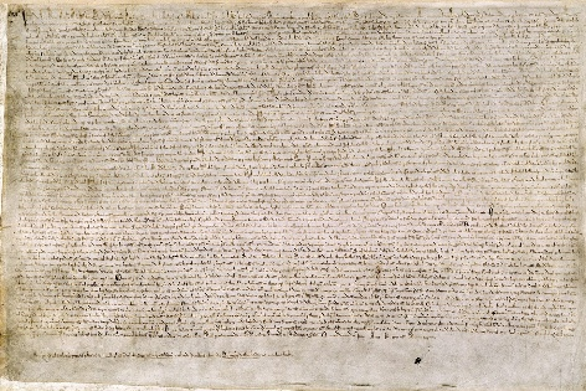
Parchment, made from cleaned and stretched animal skin, was developed long after papyrus and, thanks to its superior durability, quickly became the medium of choice for important documents. The Magna Carta, made from parchment, contains about 3,500 words or ~25,000 characters, which equates to about 200,000 bits of information. Medieval parchment weighs about 100–180 g/m², meaning the Magna Carta weighs roughly 50 grams. Using our formula, the Magna Carta’s data density comes out to around 4,000 bits/g.

Even the Magna Carta pales in comparison to modern paper with printed text. “Paper”, the flexible plant-fiber sheets we know of today, was invented in China as far back as the 2nd century B.C.. It took centuries for it to spread outside China. Paper could be made thinner and lighter than parchment or papyrus, and the printing press made it possible to fit more words on a sheet. The King James Bible, for instance, contains around 789,000 words. That’s roughly 4.3 million characters, or 34,400,000 bits of data. A standard hardcover Bible weighs about 1 kg. Even if we conservatively include the weight of the binding, the information density comes to ~34,400 bits/g, about 8.6 times the density of the Magna Carta.

Our eyesight is limited, and text can only be so small before we can no longer resolve it. The next revolution in data storage came in the form of more exotic “machine-readable” media. Examples include magnetic storage such as hard drives and magnetic tape. Here, data is encoded on magnetized material directly as bits of information – ones and zeros – by carefully controlling the polarity of magnetic domains. This technology was a wondrous breakthrough, and it’s still improving. Today, for a few hundred dollars, you can purchase a hard drive that can store tens of terabytes of data! A commercially available 10TB HDD that weighs ~1500 g can store ~80 trillion bits of data, a data density of ~53 billion bits/g, 1.54 million times higher than the King James Bible.

Yet today, hard disk drives already feel antiquated. Instead, most phones, desktops, tablets, and external drives use solid-state storage (SSDs). It’s easy to see why SSDs have become so dominant in recent years; they are ideal for mobile devices. They have no moving parts, are more durable, use less energy, and still have higher data density. Solid-state media store data by trapping electrons in a grid of floating-gate transistors to represent bits of information. A commercially available 4TB (~32 trillion bits) SSD weighs 32 grams; a data density of 1 trillion bits/g, about 19 times higher than a comparable hard drive, or about 5.3 trillion times the data density of the Rosetta Stone!

Commensurate with improvements in data density came higher read/write speeds, or “throughput.” People read about 4 words a second and with an average word length of around 5 characters; that’s about 160 bits per second. A professional stone carver might be able to write up to 20 letters an hour, or about 0.044 bits per second. Paper and paper-like media dramatically increased writing speed. A human writes about 1.1 characters per second, or roughly 8.8 bits per second – 200 times faster than carving into stone, though still slower than reading. Printing machines, of course, could print text far faster than any human could write by hand.

But none of this compares to magnetic storage, such as modern hard drives, where read/write speeds (which are similar) are currently about 4.4 billion bits per second. SSDs are faster still, reaching read/write speeds up to 112 billion bits per second. That’s about 700 million times faster than reading, and nearly 13 billion times faster than writing by hand, roughly 2.5 trillion times faster than carving into stone!

In roughly five thousand years, we’ve pushed the density of our storage media up by a factor of trillions, and the leaps keep coming faster. It took five millennia to get from stone to the printed page, representing a 180,000-fold gain in data density. In the seventy years since the invention of the hard drive, and with SSDs, humanity has multiplied that density by another 29 million times. For perspective, the text of the King James Bible carved in stone would weigh around 185 tons, nearly as much as a Boeing 747 (without fuel). On an SSD, it weighs less than a grain of sand.

Blog Post | Progress Studies

Critiques of Progress, Pt. 1: The Revolt against Modernity

Some say the modern world could be better. Others say it is rotten at the core.

Today marks the launch of a new series of essays on HumanProgress.org written by Dr. Steven Davies titled Critiques of Progress. Each of the fifteen essays in this monthly series will examine the origins, nature, and validity of recurring critiques of the modern world. This introductory essay distinguishes between two broad critiques of modernity and explains which one this series will address and why.


Today’s world is one of liberal modernity, the result of a transformative process dating back to the end of the 17th century. This process has brought enormous benefits to everyone alive today, as well as many who lived during the three centuries leading up to today. The most obvious benefit is the dramatic rise in average incomes over that period, especially globally. This rise in real incomes (and therefore living standards and material conditions) has no precedent in human history. It also started slowly and in a limited part of the globe, but it has accelerated and spread to almost every location, not steadily, but nonetheless in a progressive fashion.

However, while liberal modernity has improved human life, rising living standards are foundational but not the most important. More significant are the second-order consequences of economic growth and rising living standards, which are related but distinct. Second-order effects include a dramatic increase in the range of life options and ways of life available to ordinary people, a decline in crime and violence, a transformative change in the status and life experience of women, and improved health outcomes for people of all ranks and positions. Independent but related benefits include the enormous increase in our knowledge about, and understanding of, the natural world, and the increased sociability that comes from the shift from a rural society where most lived in small communities to a majority urban society where an increasing share of the global population lives in large cities or towns.

All of that is a transformation in the extent and variety of human flourishing. It is, by many ethical standards, the biggest improvement in human life in recorded history. Nevertheless, the modern world has as many critics as celebrants, in fact even more so. For every author or artist celebrating that things are better for most people than ever before, several complain and paint the contemporary world, or parts of it, in dark colors. At first glance, this chorus of criticism might seem united and singular, but a closer look reveals something more interesting.

On examination, criticisms of the modern world fall into two broad categories. The first are those we could call “Yes, but…”. In these arguments, critics accept the modern world as good, or at least better than what came before. Critics argue that, despite that, the modern world is deeply flawed: it is marked by deep inequality or injustice, harms the environment, or is plagued by persistent poverty, for example. In these arguments, the positive agenda is to say that the modern world needs to do better or radically reform in some way to realize its promise. It is better than the pre-modern world but has a foundational flaw that needs correction (private property and capitalism are the most common examples, but critics also cite the continued existence of the state and systemic advantages and disadvantages). These criticisms of modernity can be described as radical (or, in their milder versions, reformist).

The obvious example is Marxism. For the German philosopher Karl Marx, capitalist modernity was undoubtedly progressive at first and a clear improvement on feudalism, let alone slavery. He saw the modern world of his time as transitional, moving toward a truly liberated future where all human potential would be realized. The point of his criticisms of bourgeois society and modernity was that they had inherent contradictions and injustices that would be resolved through a dialectical process of historical development. That made the modern world unjust and flawed but also necessary and, in many ways, progressive. It was the contrast between the actuality of the modern world and what he saw as its potential that sparked his ire. He never had anything but the deepest contempt, forcefully expressed, for the apologists of the pre-modern world (as also for those whose objections to the modern world were founded in ethics rather than a ‘scientific’ approach like his own).

However, from the very first intimations of the modern world in the 1690s and 1700s, a second category of critiques emerged, of a very different type. These analyses and polemics argue that something about modernity is at least deeply regrettable, or (more often) profoundly bad. They argue that key aspects of modernity, including the ones listed earlier, should be morally condemned because of their harmful consequences for people and the natural world. The point is that these arguments don’t argue that the modern world is good but flawed, or potentially good but failing to realize that potential. Instead, they reject the modern world tout court and see the modernization process as a tragic wrong turn for all of humanity. That is a much more fundamental critique than the first type.

This second category is also more widespread, though you might not realize it because these critiques and the movements they inspire either attract little attention from scholars or are misrepresented as belonging to the first category. In reality, critiques, movements, and analyses of this kind appear in every society that begins to modernize and seem to be one of the most universal responses to that process. What is striking is how the same specific themes and arguments recur across contexts and societies that are otherwise wildly different. Ian Buruma and Avishai Margalit captured that in a remarkable little book, Occidentalism, published in 2004. They framed their work as a response to Edward Said’s Orientalism and presented the ideas and movements they analyzed as driven by a negative stereotype of “the West.” In reality, what they identified was the recurring tropes and arguments of anti-modernity (their framing came from the notion that modernization was identical to westernization – understandable but incorrect).

Buruma and Margalit captured how movements such as anti-imperialism, Japanese nationalism, 19th-century romanticism, and fascism, as well as individual intellectuals of many kinds, produced similar arguments against the world the modernization process produced and even employed similar rhetoric. This suggests that the shock of modernity triggers a similar response and analysis across traditional or pre-modern societies, regardless of how different those societies might be. These responses and arguments are not limited to political arguments and polemics. In fact, they are even more widespread in literature, historiography, and the arts. Many of the most important cultural figures of the last two centuries are associated with them; one could point to Wagner, Dostoyevsky, Ruskin, and T. S. Eliot, for example. In more popular culture we could cite authors such as Lovecraft, C. S. Lewis, Tolkien, or any number of writers of fantasy and adventure fiction.

The point is that this second category of criticisms of modernity attacks the very idea and foundational features of the modern. What most people, including the first kind of critic, would celebrate is seen as something to regret or deplore. A common theme is that the modern world, or main and essential aspects of it, are incompatible with human nature, with what it is to be human and to live a truly human life. If the more familiar kinds of critique can be labelled “radical” then these can be described as “conservative” or “reactionary.” We should be cautious about those terms, however. Although many of the exponents did indeed see themselves as conservatives or reactionaries, many did not.  They are not often seen as radical opponents of the status quo – although increasingly, as time passed, that is what they were. Many also regret modernity but see it as irreversible and argue for “reactionary modernism,” in which high technology and science combine with deeply anti- or pre-modern beliefs and social structures. This kind of view is found in people as varied as fascists and Nazis, ante-bellum fire-eaters, and many nationalist movements.

What are some examples of the family of arguments we are speaking of here? To give a few: that the modern world is godless and denies the transcendent; that it degrades the nature and meaning of personal relationships, making them ephemeral and insignificant; that it destroys the concept of honor and a whole range of virtues, replacing them with base materialism; that it undermines true connection between people and true community for a deracinated individualism; that it destroys excellence in the name of bland equality and uniformity; that it separates humans from the natural world; that it destroys true masculinity and femininity and the proper relations between men and women; and that it cuts the connection between people and places, rendering all of us rootless.

Over the next fourteen essays, we will explore the second kind of critique of progress and other arguments, examining what lies behind them, the forms they take, and why they are sometimes factually incorrect and usually grounded in false moral principles. We are familiar with the first kind of critique, but increasingly we need to address these more foundational and fundamental ones.

Blog Post | Progress Studies

Why Our Economic Intuitions Are Often Wrong

Such tendencies stem from our evolutionary psychology.

Summary: Many common economic misconceptions stem from evolved psychological instincts shaped in small, zero-sum tribal environments rather than modern market systems. These “folk-economic beliefs” lead people to misinterpret trade, immigration, profit, and regulation in ways that conflict with core economic principles, often resulting in support for counterproductive policies. Because these intuitions are predictable products of human evolution, they help explain why flawed policy ideas persist. Recognizing their origins can help counteract misleading instincts while reinforcing those that support cooperation, openness, and exchange.


Economic models, rooted in assumptions of rational agents maximizing utility under constraints, have long provided elegant frameworks for understanding human behavior in markets and societies. Yet, a persistent friction exists between these idealized portrayals of human beings and the ways humans actually navigate economic choices. People frequently champion policies that contravene basic economic principles, including minimum wages presumed to boost income without increasing unemployment, rent controls expected to enhance housing affordability without reducing supply, or tariffs that run counter to comparative advantage and affordability. 

People also often harbor counterproductive intuitions, including a belief that markets erode social bonds, despite evidence that markets foster cooperation and thus generate wealth. Those tendencies stem not primarily from information deficits or irrationality, but from our evolutionary psychology. Our economic intuitions were shaped over thousands of years in a world of tight-knit coalitions and zero-sum intergroup rivalry, rendering modern market dynamics counterintuitive. As such, markets are often rejected even when they are beneficial.

Perhaps the most parsimonious theory explaining why people often behave in economically harmful ways is the evolutionary cognitive model of folk-economic beliefs, proposed by anthropologist Pascal Boyer and political scientist Michael Bang Petersen. Folk-economic beliefs are those convictions about economics held by laypeople untrained in the discipline, which frequently diverge from fundamental economic tenets. These encompass mental representations of varied topics, from prices, taxes, and tariffs to welfare and immigration policies. 

Economists have traditionally critiqued those as irrational beliefs or mere byproducts of ignorance, but an evolutionary lens reveals them as predictable outcomes. Ensuring fairness in trade, sustaining social ties, forming stable coalitions, and resolving ownership disputes are all responses to ancestral challenges.

If this theory is right, both actual economic behavior and theories generated to explain one’s own economic behavior are predictable outputs shaped by evolution. When folk-economic beliefs are wrong, they are wrong in predictable ways. We talk about impersonal markets as if they were tribal conflicts. We treat economies built on innovation and surplus as if they were competitions over a fixed pile of resources.

Consider the intuition that international trade is harmful because another country’s gain must come at our expense. From the perspective of standard economics, this belief contradicts the well-established principle of comparative advantage. People benefit from specializing in what they produce most efficiently relative to other goods, even if a trading partner could produce everything more cheaply in absolute terms. For example, a surgeon who happens to type faster than his or her secretary still benefits from hiring the secretary and devoting more time to the operating room. Likewise, America could manufacture its own consumer electronics, but every dollar and worker devoted to assembling phones is one not devoted to designing the software, chips, and financial services where American companies dominate globally. The result is more total output and mutual gain. 

But our evolutionary psychology wasn’t built for comparative advantage, especially not across nations or tribes. Human groups historically competed for territory, food, and status in genuinely zero-sum ways. If a rival coalition grew stronger, it often meant danger for one’s own group. When modern individuals read that another nation is exporting more goods to us or running a trade surplus, our tribal instincts activate automatically. Nations are cognitively represented as tribes, and the success of one tribe is interpreted as a threat to another. The idea that both sides could benefit simultaneously—one of the central insights of the founder of economics, Adam Smith—runs against these deeply ingrained intuitions.

The same coalitional logic helps explain folk intuitions about immigration. People opposed to immigration often claim that immigrants steal jobs from native workers while also claiming that immigrants siphon welfare benefits without working. At the level of policy argument, these beliefs are apparently contradictory. But at the level of psychology, it is an expression of a single concern: Outsiders are draining scarce resources, whether the resource is employment or benefits. Humans evolved in groups where membership conferred access to shared resources—food, protection, or status—and where vigilance against free riders was essential to sustaining cooperation. Newcomers were therefore automatically treated with suspicion until they proved themselves contributors rather than exploiters. 

When this ancestral heuristic is applied to modern societies, it produces the intuition that outsiders must be consuming resources that properly belong to the in-group. Whether the imagined resource is employment or welfare benefits—or even whether the resources are truly being drained at all—matters less than the perceived threat that group boundaries are being crossed without reciprocal contribution.

The psychology of free-rider detection also helps explain the peculiar ambivalence that many people feel toward welfare programs. While people readily endorse the idea that society should help those who fall on hard times through no fault of their own, they also often worry that welfare encourages laziness or dependency. These views appear inconsistent only if one assumes that the public is applying a unified economic theory. In reality, they reflect two separate intuitions inherited from ancestral exchange systems. 

Communal sharing evolved as a form of insurance against bad luck—injury, illness, or an unsuccessful hunt—where helping unlucky group members benefited everyone in the long run. But the same systems also evolved to punish individuals who accepted benefits without contributing. Modern welfare debates, therefore, activate both intuitions simultaneously: compassion toward the unlucky and hostility toward perceived free riders.

Another common folk-economic belief concerns the relationship between labor and value. Many people feel instinctively that hard work should determine how much something is worth. In the hunter-gatherer economy that prevailed throughout most of human history, where the value of goods was closely tied to the labor required to obtain them, strenuous physical effort was intrinsically linked to value production itself. Hunting, gathering, building shelter, or crafting tools all involved visible effort, and individuals who contributed more effort typically produced more resources. When applied to modern economies, however, the same intuition can generate confusion. A programmer writing code, an entrepreneur coordinating supply chains, or an investor allocating capital may create enormous value without performing visible physical labor. Yet because our ownership psychology is sensitive to effort and physical transformation, profits earned through organization or innovation are often framed as morally suspect, particularly in socialist ideology, as if they are thought to represent extraction rather than creation.

Some common opposition to the profit motive itself is explained by evolutionary psychology. In face-to-face exchange within small groups, unusually large gains might indeed signal exploitation or hoarding of limited resources, especially since producing anything of value typically required communal effort. Someone who consistently benefited more than others from trades might be suspected of manipulating information or violating norms of fairness. Modern markets, however, often reward individuals precisely when they discover new ways to produce value—whether by inventing technologies, improving logistics, or coordinating complex networks of production. Because these gains arise in impersonal systems where the beneficiaries are distant strangers rather than known partners, the profits they generate can appear less like the rewards of innovation and more like evidence of exploitation. Our evolved moral intuitions struggle to track value creation in dispersed and opaque market economies. 

Likewise, many popular beliefs about regulation reflect ancestral intuitions that authorities can directly control outcomes. If the chieftain declared that food should be shared in a particular way, the order could be enforced through social pressure or direct monitoring. Everyone knew everyone else, contributions were visible, and deviations from the rule could be punished immediately. This experience makes it intuitively plausible that governments—which our minds intuitively represent as tribal coalitions—can simply command economic results. If rents are too high, they can seemingly be capped. If wages are too low, they can seemingly be raised. In naive folk economic theories, prices behave like promises: If the authority decrees a new price, the outcome should follow.

Take rent control. The intuition behind it is straightforward and morally compelling. If landlords raise rents beyond what tenants can afford, people may feel exploited: The owner of a scarce resource is extracting more money without providing more housing. A government rule limiting rents, therefore, appears to be a simple act of fairness. Ostensibly, the authority steps in, declares that rents may not exceed a certain level, and housing becomes affordable again. But in a large market economy, rent is not just a moral claim between two parties; it is also a signal that coordinates investment and construction of new housing. When rents are capped below market levels, the signal changes. Developers build fewer apartments, landlords convert rental units into other uses, and maintenance becomes less attractive when returns are limited. Over time, the supply of housing shrinks, and the shortage intensifies the very scarcity that drove up rents in the first place. The policy fails because the mechanism through which housing supply adjusts is invisible to the mental model that produced the intuition.

The same dynamic appears in debates over minimum wages. If workers are paid very little for difficult or unpleasant jobs, the situation feels unfair. But in a modern labor market, wages also function as signals that coordinate hiring decisions across the entire economy. When the legal wage floor rises above the productivity level of some jobs, employers do not simply pay the higher wage and continue as before. They reduce hiring, substitute machines for labor, or restructure tasks so fewer workers are needed. When the price signal changes, behavior adjusts in ways that the regulation does not anticipate. That often results in the direct opposite of the desired effect.

Our minds are not utility-maximizing computers that simply deviate from optimal choice due to insufficient information or computing power. They are toolkits. Our brains have evolved specialized cognitive inferences, or intuitions, that solved specific recurrent problems in our ancestral environments: “Who is trustworthy enough for exchange?”; “Who belongs to us, and who is a rival?”; “Who is contributing, and who is free riding?”; “Who owns what, and by what right?” These intuitions can be triggered by modern economic situations that resemble ancestral ones, even when the actual circumstances are entirely new. 

Folk-economic beliefs persist not because people are irrational, but because they are reasoning with tools that evolved for cooperation in small bands rather than coordination among millions of strangers. The challenge for modern societies is therefore not simply to correct mistaken beliefs, but to build policies that work with—rather than against—the grain of human psychology. 

Modern market societies represent one of humanity’s most remarkable cultural achievements. They sprang into existence by harnessing a set of different ancient social instincts—ones that enable cooperation on an unprecedented scale. Systems of property rights, contract enforcement, and voluntary exchange allow millions of strangers to coordinate their efforts in mutually beneficial ways. 

The claim here is not that markets are infallible. It is that our evolved intuitions often misidentify the nature of the problem and thus point us toward remedies that make matters worse. In modern economies, visible losses are concentrated, immediate, and emotionally salient, while gains are diffuse, gradual, and spread across millions of consumers and workers. A serious defense of markets should therefore acknowledge adjustment costs and real harms without conceding the larger error: namely, the belief that mutual gain, price signals, profit, and exchange are themselves forms of exploitation.

Some of our evolved instincts—like valuing reciprocity, rewarding contribution, and building reputations for trustworthiness—remain essential foundations of prosperous societies. Markets themselves depend on these deeply rooted norms of cooperation and exchange. Other intuitions, however—such as zero-sum thinking about trade, suspicion toward profitable innovation, or faith that authorities can simply command prices—reflect cognitive shortcuts suited to environments of scarcity and small-group control rather than decentralized abundance.

Recognizing that distinction should not slide into a blanket dismissal of public concern. Not every market outcome is benign, and not all economic anxieties are mere illusions. Trade, technological change, and broader shifts from manufacturing to services can impose real, concentrated losses on particular workers, firms, and regions, especially on lower-skill laborers whose jobs are exposed to offshoring or displaced by new forms of production. A person who loses a job to foreign competition is not simply trapped by faulty intuition. He is often responding to a real personal setback, even if the economy as a whole still becomes more productive and prosperous. The same is true in recessions or cases of fraud and negative externalities. 

The question, then, is how societies can address those real costs without defaulting to the very intuitions that misdiagnose their causes. 

Human beings are unusual among species in our ability to revise intuitive judgments through abstract reasoning and accumulated knowledge. Economic theory, empirical evidence, and institutional experimentation provide ways of testing whether our intuitions about markets actually match the systems we inhabit. Over time, societies that learn to distinguish between intuitions that promote cooperation and those that misread economic signals tend to design more effective institutions. 

Much of the progress of the last two centuries reflects this process of institutional learning precisely. Expanding trade networks, protecting property rights, encouraging innovation, and allowing prices to coordinate decentralized decisions have produced levels of prosperity that would have been unimaginable in the environments where our economic intuitions evolved. Understanding the evolutionary roots of folk-economic beliefs, therefore, helps explain why certain policy ideas remain politically attractive despite poor outcomes—and why sustained progress often depends on institutions that counteract some of our most natural intuitions while reinforcing others that support cooperation, openness, and exchange.

This article was originally published at The Dispatch on 4/21/2026.

Blog Post | Water & Sanitation

If You Think New York City Life Is Bad Now

A grim tour of preindustrial New York

Summary: Many people today feel that life in New York has become uniquely difficult. Some imagine that the city was cleaner, safer, and more livable in the distant past. Historical reality tells a different story: Preindustrial New York was marked by extreme filth, unsafe water, rampant disease, pervasive poverty, and living conditions that made everyday life harsh and dangerous compared to contemporary times.


Discontent fueled the 2025 New York City mayoral election and Zohran Mamdani’s victory. A common theme echoed across the five boroughs: New York is a hard place to live. “We are overwhelmed by housing costs,” said Santiago, a 69-year-old retiree, outside a Mamdani rally. Those opposed to Mamdani had their own complaints. María Moreno, a first-time voter from the Bronx who supported Andrew Cuomo, lamented, “Now everything’s dirty, and our neighborhood does not feel safe.”

Today’s voters have legitimate grievances. The city’s housing costs, quality-of-life issues, and perceptions of disorder weigh heavily on residents’ minds. But it’s important to keep things in perspective. Different voters may romanticize different eras, but many seem to share a sense that if they could travel back far enough in time, they’d find a New York that was once clean, safe, and affordable. When Americans were polled in 2023, almost 20 percent said that it was easier to “have a thriving and fulfilling life” hundreds of years ago. Across the country, as one writer put it, people are engaged in an “endless debate around whether the preindustrial past was clearly better than what we have now.” In fact, Mamdani’s politics are grounded in an ideology that first arose from the frustrations of the early industrial era.

If Americans could go back in time to preindustrial New York City, however, they’d likely be horrified and possibly traumatized. Despite today’s real challenges, most New Yorkers would not trade places with their predecessors.

Long before the rise of factories and industry, New York City was a bustling port, founded by the Dutch as New Amsterdam in order to trade furs in the early seventeenth century. As early as 1650, local authorities enacted an ordinance against animals roaming the streets to protect local infrastructure—but to no avail. Then, in 1657, according to the Dutch scholar Jaap Harskamp:

New Amsterdam’s council attempted to ban the common practice of throwing rubbish, ashes, oyster-shells or dead animals in the street and leave the filth there to be consumed by droves of pigs on the loose. When the English took over the colony from the Dutch, pigs and goats stayed put. . . . Pollution persisted. The streets of Manhattan were a stinking mass. Inhabitants hurled carcasses and the contents of loaded chamber pots into the street and rivers. Runoff from tanneries where skins were turned into leather flowed into the waters that supplied the shallow wells. The (salty) natural springs and ponds in the region became contaminated with animal and human waste. For some considerable time, access to clean water remained an urgent problem for the city. . . . The penetrating smell of decomposing flesh was everywhere.

Into the early twentieth century, urban living in the United States felt surprisingly rural and agrarian, with an omnipresent reek to match. As late as the mid-nineteenth century, pigs roamed freely through New York City streets, acting as scavengers, and nearly every household maintained a vegetable garden, often fertilized with animal manure.

Indoor air quality was no better. A drawing from Mary L. Booth’s History of the City of New York depicts a seventeenth century New Amsterdam home with smoke from the fireplace swirling through the room. Indoor air pollution remains a serious problem today in the poorest parts of the world, as smoke from hearths can cause cancer and acute respiratory infections that often prove deadly in children. One preindustrial writer railed against the “pernicious smoke [from fireplaces] superinducing a sooty Crust or furr upon all that it lights, spoyling the moveables, tarnishing the Plate, Gildings and Furniture, and Corroding the very Iron-bars and hardest stone with those piercing and acrimonious Spirits which accompany its Sulphur.”

That said, before industrialization, though inescapable filth coated the interiors of homes, the average person owned few possessions for the corrosive hearth smoke and soot to ruin. By modern standards, New Yorkers—like most preindustrial people—were impoverished and lacked even the most basic amenities. According to historian Judith Flanders, in the mid-eighteenth century, “fewer than two households in ten in some counties of New York possessed a fork.” Many were desperately poor even by the standards of the day and could not afford housing. One 1788 account lamented how in New York City, “vagrants multiply on our Hands to an amazing Degree.” Charity records suggest that the “outdoor poor” far outnumbered those in almshouses.

Water quality was infamously awful. In seventeenth-century New Amsterdam, as Benjamin Bullivant observed, “[There are] many publique wells enclosed & Covered in ye Streetes . . . [which are] Nasty & unregarded.” A century later, New York’s water remained as foul as Bullivant had described. Visiting in 1748, the Swedish botanist Peter Kalm noted that the city’s well water was so filthy that horses from out of town refused to drink it. In 1798, the Commercial Advertiser condemned Manhattan’s main well as “a shocking hole, where all impure things center together and engender the worst of unwholesome productions; foul with excrement, frogspawn, and reptiles, that delicate pump system is supplied. The water has grown worse manifestly within a few years. It is time to look out [for] some other supply, and discontinue the use of a water growing less and less wholesome every day. . . . It is so bad . . . as to be very sickly and nauseating; and the larger the city grows the worse this evil will be.”

In 1831, a letter in the New York Evening Journal described the state of the water supply:

I have no doubt that one cause of the numerous stomach affections so common in this city is the impure, I may say poisonous nature of the pernicious Manhattan water which thousands of us daily and constantly use. It is true the unpalatableness of this abominable fluid prevents almost every person from using it as a beverage at the table, but you will know that all the cooking of a very large portion of the community is done through the agency of this common nuisance. Our tea and coffee are made of it, our bread is mixed with it, and our meat and vegetables are boiled in it. Our linen happily escapes the contamination of its touch, “for no two things hold more antipathy” than soap and this vile water.

In 1832, New York experienced a devastating outbreak of cholera, a bacterial disease that typically spread through contaminated water and killed with remarkable speed. A person could wake up feeling well and be dead by nightfall, struck down with agonizing cramps, vomiting, and diarrhea. The epidemic killed about 3,500 New Yorkers.

The initial actions taken to protect city water supplies were often private in nature. In fact, throughout the eighteenth and early nineteenth centuries, private businesses generally supplied urban water infrastructure. Despite such efforts, drinking water remained generally unsafe, even after industrialization, until the chlorination of urban water supplies became widespread.

The pervasive grime took a visible toll on New Yorkers. Between drinking tainted water, eating contaminated food, inhaling smoke-filled air, and living with poor hygiene, the average resident sported visibly rotten teeth. One letter from 1781 described an acquaintance: “Her teeth are beginning to decay, which is the case with most New York girls, after eighteen.”

The dental practices of the time were often as horrifying as the effects of neglect. The medieval method of using arsenic to kill gum tissue, providing pain relief by destroying nerve endings, remained common until the introduction of Novocain in the twentieth century. As late as 1879, the New York Times ran a story with the headline “Fatal Poison in a Tooth; What Caused the Horrible Death of Mr. Gardiner. A Man’s Head Nearly Severed from His Body by Decay Caused by Arsenic Which Had Been Placed in One of His Teeth to Deaden an Aching Nerve—an Extraordinary Case.” The story detailed the gruesome demise of a man in Brooklyn, George Arthur Gardiner, who died “in great agony, after two weeks of indescribable suffering.”

Preindustrial New York City wasn’t uniquely miserable for its time. Life was harsh everywhere, and cities around the world contended with the same foul smells, filth, poor sanitation, and grinding poverty. Rural villages were no better. Peasant families often brought their livestock indoors at night and slept huddled together for warmth. In many cases, rural peasants were even poorer than their urban counterparts and owned fewer possessions. Farm laborers frequently suffered injuries and aged prematurely from backbreaking work, while fertilizing cesspits spread disease and filled the air with an inescapable stench.

Though they may have been slightly better off than their rural counterparts, the struggles of early New Yorkers are worth remembering. However daunting the problems of today may seem, a proper historical perspective can remind us of how far we’ve come.

This article was originally published in City Journal on 1/13/2026.

Blog Post | Human Development

The Grim Truth About the “Good Old Days”

Preindustrial life wasn’t simple or serene—it was filthy, violent, and short.

Summary: Rose-tinted nostalgia for the preindustrial era has gone viral—some people claim that modernity itself was a mistake and that “progress” is an illusion. This article addresses seven supposed negative effects of the Industrial Revolution. The conclusion is that history bears little resemblance to the sanitized image of preindustrial times in the popular imagination.


When Ted Kaczynski, the Unabomber, declared in 1995 that “the Industrial Revolution and its consequences have been a disaster for the human race,” he was voicing a sentiment that now circulates widely online.

Rose-tinted nostalgia for the preindustrial era has gone viral, strengthened by anxieties about our own digital era. Some are even claiming that modernity itself was a mistake and that “progress” is an illusion. Medieval peasants led happier and more leisurely lives than we do, according to those who pine for the past. “The internet has become strangely nostalgic for life in the Middle Ages,” journalist Amanda Mull wrote in a piece for The Atlantic. Samuel Matlack, managing editor of The New Atlantis, observed that there is currently an “endless debate around whether the preindustrial past was clearly better than what we have now and we must go back to save humanity, or whether modern technological society is unambiguously a forward leap we must forever extend.”

In the popular imagination, the Industrial Revolution was the birth of many evils, a time when smoke-belching factories disrupted humanity’s erstwhile idyllic existence. Economics professor Vincent Geloso’s informal survey of university students found that they believed “living standards did not increase for the poor; only the rich got richer; the cities were dirty and the poor suffered from ill-health.” Pundit Tucker Carlson has even suggested that feudalism was preferable to modern liberal democracy.

Different groups tend to idealize different aspects of the past. Environmentalists might idealize preindustrial harmony with nature, while social traditionalists romanticize our ancestors’ family lives. People from across the political spectrum share the sense that the Industrial Revolution brought little real improvement for ordinary people.

In 2021, History.com published “7 Negative Effects of the Industrial Revolution,” an article reflecting much of the thinking behind the popular impression that industrialization was a step backward for humanity, rather than a period of tremendous progress. But was industrialization really to blame for each of the ills detailed in the article?

“Horrible Living Conditions for Workers”

Were horrible living conditions a result of industrialization? To be sure, industrial-era living conditions did not meet modern standards—but neither did the living conditions that preceded them.

As historian Kirstin Olsen put it in her book, Daily Life in 18th-Century England, “The rural poor . . . crowded together, often in a single room of little more than 100 square feet, sometimes in a single bed, or sometimes in a simple pile of shavings or straw or matted wool on the floor. In the country, the livestock might be brought indoors at night for additional warmth.” In 18th-century Wales, one observer claimed that in the homes of the common people, “every edifice” was practically a miniature “Noah’s Ark” filled with a great variety of animals. One shudders to think of the barnlike smell that bedchambers took on, in addition to the chorus of barnyard sounds that likely filled every night. Our forebears put up with the stench and noise and cuddled up with their livestock, if only to stave off hypothermia.

Homes were often so poorly constructed that they were unstable. The din of collapsing buildings was such a common sound that in 1688, Randle Holme defined a crash as “a noise proceeding from a breach of a house or wall.” The poet Dr. Samuel Johnson wrote that in 1730s London, “falling houses thunder on your head.” In the 1740s, “props to houses” keeping them from collapsing were listed among the most common obstacles that blocked free passage along London’s walkways.

“Poor Nutrition”

What about poor nutrition? From liberal flower children to the “Make America Healthy Again” crowd, fetishizing the supposedly chemical-free, wholesome diets of yore is bipartisan. The truth, however, is stomach-churning.

Our ancestors not only failed to eat well, but they sometimes didn’t eat at all. Historian William Manchester noted that in preindustrial Europe, famines occurred every four years on average. In the lean years, “cannibalism was not unknown. Strangers and travelers were waylaid and killed to be eaten.” Historian Fernand Braudel recorded a 1662 account from Burgundy, France, that lamented that “famine this year has put an end to over ten thousand families . . . and forced a third of the inhabitants, even in the good towns, to eat wild plants. . . . Some people ate human flesh.” A third of Finland’s population is estimated to have died of starvation during a famine in the 1690s.

Even when food was available, it was often far from appetizing. Our forebears lived in a world where adulterated bread and milk, spoiled meat, and vegetables tainted with human waste were everyday occurrences. London bread was described in a 1771 novel as “a deleterious paste, mixed up with chalk, alum and bone ashes, insipid to the taste and destructive to the constitution.” According to historian Emily Cockayne, the 1757 public health treatise Poison Detected noted that “in 1736 a bundle of rags that concealed a suffocated newborn baby was mistaken for a joint of meat by its stinking smell.”

Water was also far from pristine. “For the most part, filth flowed out windows, down the streets, and into the same streams, rivers, and lakes where the city’s inhabitants drew their water,” according to environmental law professor James Salzman. This ensured that each swig included a copious dose of human excreta and noxious bacteria. Waterborne illnesses were frequent.

“A Stressful, Unsatisfying Lifestyle”

Did stressful lifestyles originate with industrialization? Did our preindustrial ancestors generally enjoy a sense of inner peace? Doubtful. Sadly, many of them suffered from what they called melancholia, roughly analogous to the modern concepts of anxiety and depression.

In 1621, physician Robert Burton described a common symptom of melancholia as waking in the night due to mental stress among the upper classes. An observer said the poor similarly “feel their sleep interrupted by the cold, the filth, the screams and infants’ cries, and by a thousand other anxieties.” Richard Napier, a 17th-century physician, recorded over several decades that some 20 percent of his patients suffered from insomnia. Today, in comparison, 12 percent of Americans say they have been diagnosed with chronic insomnia. Stress is nothing new.

Sky-high preindustrial mortality rates caused profound emotional suffering to those in mourning. Losing a child to death in infancy was once a common—indeed, near-universal—experience among parents, but the loss was no less painful for all its ordinariness. Many surviving testimonies suggest that mothers and fathers felt acute grief with each loss. The 18th-century poem, “To an Infant Expiring the Second Day of Its Birth,” by Mehetabel “Hetty” Wright—who lost several of her own children prematurely—heartrendingly urges her infant to look at her one last time before passing away.

So common were child deaths that practically every major poet explored the subject. Robert Burns wrote “On the Birth of a Posthumous Child.” Percy Bysshe Shelley wrote multiple poems to his deceased son. Consider the pain captured by these lines from William Shakespeare’s play King John, spoken by the character Constance upon her son’s death: “Grief fills the room up of my absent child. . . . O Lord! My boy, my Arthur, my fair son! My life, my joy, my food, my all the world!” Shakespeare’s own son died in 1596, around the time the playwright would have finished writing King John.

Only in the modern world has child loss changed from extraordinarily common to exceedingly rare. As stressful as modern life can be, our ancestors faced forms of heartache that most people today will never endure.

“Dangerous Workplaces” and “Child Labor”

Dangerous workplaces and child labor both predate the Industrial Revolution. In agrarian societies, entire families would labor in fields and pastures, including pregnant women and young children. Many preindustrial children entered the workforce at what today would be considered preschool or kindergarten age.

In poorer families, children were sent to work by age 4 or 5. If children failed to find gainful employment by age 8, even social reformers unusually sympathetic to the plight of the poor, would express open disgust at such a lack of industriousness. Jonas Hanway was reportedly “revolted by families who sought charity when they had children aged 8 to 14 earning no wages.”

For most, work was backbreaking and unending. A common myth suggests that preindustrial peasants worked fewer days than modern people do. This misconception originated from an early estimate by historian Gregory Clark, who initially proposed that peasants labored only 150 days a year. He later revised this figure to around 300 days—higher than the modern average of 260 working days, even before factoring in today’s paid holidays and vacation time.

Physically harming one’s employees was once widely accepted, too, and authorities stepped in only when the mistreatment was exceptionally severe. In 1666, one such case occurred in Kittery, in what is now Maine, when Nicholas and Judith Weekes caused the death of a servant. Judith confessed that she cut off the servant’s toes with an axe. The couple, however, was not indicted for murder, merely for cruelty.

“Discrimination Against Women”

The preindustrial world was hardly a model of gender equality—discrimination against women was not an invention of the early industrialists but a long-standing feature of many societies.

Domestic violence was widely tolerated. In London, a 1595 law dictated: “No man shall after the houre of nine at the Night, keepe any rule whereby any such suddaine out-cry be made in the still of the Night, as making any affray, or beating hys Wife, or servant.” In other words, no beating your wife after 9:00 p.m. That was a noise regulation. A similar law forbade using a hammer after 9:00 p.m. Beating one’s wife until she screamed was an ordinary and acceptable activity.

Domestic violence was celebrated in popular culture, as in the lively folk song “The Cooper of Fife,” a traditional Scottish tune that inspired a country dance and influenced similar English and American ballads. To modern ears, the contrast between its violent lyrics and upbeat melody is unsettling. The song portrays a husband as entirely justified in his acts of domestic violence, inviting the audience to side with the wifebeater and cheer as he beats his wife into submission for her failure to perform domestic chores to her husband’s satisfaction.

Sexist laws often empowered men to abuse women. If a woman earned money, her husband could legally claim it at any time. For instance, in 18th-century Britain, a wife could not enter into contracts, make a will without her husband’s approval, or decide on her children’s education or apprenticeships; moreover, in the event of a separation, she automatically lost custody. Mistreatment of women, in other words, long predated industrialization. Arguably, it was the increase in female labor force participation during the Industrial Revolution that ultimately gave women greater economic independence and strengthened their social bargaining power.

“Environmental Harm”

While many of today’s environmental challenges—such as climate change and plastic pollution—differ from those our forebears faced, environmental degradation is not a recent phenomenon. Worrying about environmental impact, however, is rather new. Indeed, as historian Richard Hoffmann has pointed out, “Medieval writers often articulated an adversarial understanding of nature, a belief that it was not only worthless and unpleasant, but actively hostile to . . . humankind.”

Consider deforestation. The Domesday Survey of 1086 found that trees covered 15 percent of England; by 1340, the share had fallen to 6 percent. France’s forests more than halved from about 30 million hectares in Charlemagne’s time (768–814) to 13 million by Philip IV’s reign (1285–1314).

Europe was hardly the only part of the world to abuse its forests. A 16th-century witness observed that at every proclamation demanding more wood for imperial buildings, the peasants of what are today the Hubei and Sichuan provinces in China “wept with despair until they choked,” for there was scarcely any wood left to be found.

Despeciation is also nothing new. Humans have been exterminating wildlife since prehistory. The past 50,000 years saw about 90 genera of large mammals go extinct, amounting to over 70 percent of America’s large species and over 90 percent of Australia’s. 

Exterminations of species occurred throughout the preindustrial era. People first settled in New Zealand in the late 13th century. In only 100 years, humans exterminated 10 species of moa in addition to at least 15 other kinds of native birds, including ducks, geese, pelicans, coots, Haast’s eagle, and an indigenous harrier. Today, few people realize that lions, hyenas, and leopards were once native to Europe, but by the first century, human activity eliminated them from the continent. The final known auroch, Europe’s native wild ox, was killed in Poland by a noble hunter in 1627.

Progress Is Real

History bears little resemblance to the sanitized image of preindustrial times in the popular imagination—that is, a beautiful scene of idyllic country villages with pristine air and residents merrily dancing around maypoles. The healthy, peaceful, and prosperous people in this fantasy of pastoral bliss do not realize their contented, leisurely lives will soon be disrupted by the story’s villain: the dark smokestacks of the Industrial Revolution’s “satanic mills.”

Such rose-colored views of the past bear little resemblance to reality. A closer look shatters the illusion. The world most of our ancestors faced was in fact more gruesome than modern minds can fathom. From routine spousal and child abuse to famine-induced cannibalism and streets that doubled as open sewers, practically every aspect of existence was horrific.

A popular saying holds that “the past is a foreign country,” and based on recorded accounts, it is not one where you would wish to vacation. If you could visit the preindustrial past, you would likely give the experience a zero-star rating. Indeed, the trip might leave you permanently scarred, both physically and psychologically. You might long to unsee the horrors encountered on your adventure and to forget the shocking, gory details.

The upside is that the visit would help deromanticize the past and show how far humanity has truly come—emphasizing the utter transformation of everyday lives and the reality of progress.

This article was published at Big Think on 11/19/2025.