
01 / 05
Have Eggs Ever Been More Expensive?

Blog Post | Food Prices

Have Eggs Ever Been More Expensive?

The money price of eggs is higher than in 1919, but the time price is lower.

The high price of eggs may have incentivized a burglar to heist 100,000 eggs from the back of a trailer in Pennsylvania. Have eggs ever been more expensive? The surprising answer is yes—much more. In 1919, eggs were five to six times more expensive: A dozen eggs were 61 cents, or around 5 cents per egg. Wages for unskilled workers at the time were around 25 cents per hour, so these workers had to spend around 12 minutes to earn the money to buy one egg.
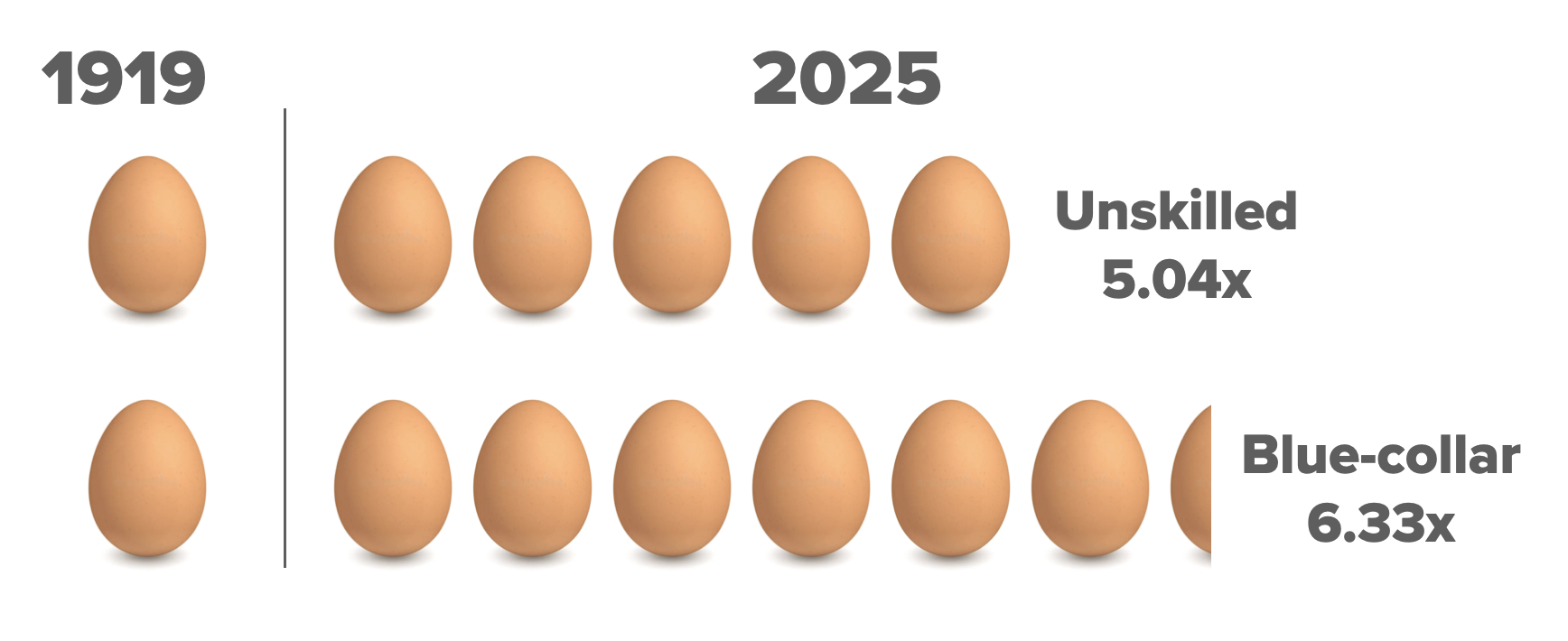
Eggs at Walmart at the time of writing (Feb 14) are $8.32 per dozen, but unskilled worker wages and benefits have increased to $17.17 an hour. That would put the time price for one egg at 2.4 minutes. The time price for unskilled workers has decreased by 80 percent since 1919. For the time required to earn the money to buy one egg in 1919, unskilled workers get five today. They’re 400 percent better off.

How about blue-collar workers? Wages for blue-collar workers in 1919 were around 43 cents per hour, so an egg cost them 7 minutes. They’re now earning $37.15 an hour, so their time price for one egg is 1.1 minute. The time price for skilled workers has decreased by 84 percent since 1919. They get 6.33 eggs today for the time it took to buy one egg in 1919. They’re 533 percent better off.

Yes, the money price of an egg today compared to 1919 is high, but the time price is much lower. Always compare the money price to hourly wages to see the time price, since that is the true price we pay for things.

Why did the price jump so high? The USDA recently ordered the culling of millions of chickens in response to worries about bird flu. Reduce supply like that and prices are bound to increase.

Fortunately for us, chickens lay lots of eggs, so the market should be resupplied soon. I have such great faith in our egg-laying friends and free-market entrepreneurs that I’m willing to bet $1 that the time price of eggs will be lower in February 2026 than today. Any takers?

Find more of Gale’s work at his Substack, Gale Winds.

Phys.org | Food Production

Norway’s Automated Farm Sends Lettuce to Stores

“Norway's first fully automated facility for vegetable production was put into operation last fall. This spring, the first products hit store shelves…

'In this facility, no one touches the lettuce from the time it is sown, grown and packaged until it ends up on the store shelf and is finally opened by the customer at home in their kitchen,' says SINTEF researcher Ottar Bakås.”

From Phys.org.

Phys.org | Cultivated Areas

US Irrigation Avoids More Emissions Than It Emits

“Irrigating U.S. crops prevents higher greenhouse gas emissions by avoiding land conversion, new research by Colorado State University shows. Agricultural irrigation allows the United States to grow more food on less land. If irrigation were suddenly shut off, the land-use change required to make up for lost yields would produce significantly more greenhouse gas emissions than irrigation emits—363 times more.

CSU scientists estimate the emissions saved by avoiding land-use change would equate to 363 years' worth of today's U.S. annual greenhouse gas emissions from irrigation.

Converting natural ecosystems to agricultural use releases carbon stored in soil and vegetation. Land use and land conversion for agriculture to produce food, fiber and fuel contribute nearly a quarter of global greenhouse gas emissions, making the sector a key priority for emissions reductions, the study published in Proceedings of the National Academy of Sciences states.”

From Phys.org.

CGIAR | Food Production

More Can Tho Rice Farmers Adopt Mechanized Seeding

“When the Fertilize Right (FerRight) project began working with rice farmers in Can Tho's Thanh An, Thanh Phu, Thoi Xuan, and Trung Hung communes, mechanized direct seeded rice (mDSR) was practiced by fewer than 1 in 100 of them. Two years later, the project's midline farmer survey found that 18% of farmers in these communes had adopted the technology — up from a 2023 baseline of just 0.7%. Fertilizer deep placement, a complementary practice often paired with mDSR, has also taken hold, now reaching 0.5% of farmers and growing. Together, the numbers are one of the clearest signals yet that the project, funded by the United States Department of Agriculture (USDA) and implemented by the International Rice Research Institute (IRRI), is changing how farmers cultivate their rice.

Unlike traditional broadcast seeding, mDSR, paired with fertilizer deep placement, uses dynamic, air-assisted row seeders to place seed precisely 1 to 2 mm into the soil and deliver nutrients directly to the root zone. Multi-season field trials with the Cuu Long Rice Research Institute (CLRRI), spanning four crops from 2024 to 2026, show why the technology is catching on: seed rates fall by at least 50%, nitrogen fertilizer use drops by at least 20%, and the carbon footprint per kilogram of rice produced falls by at least 10%, alongside more uniform stands and greater resilience to pests, disease, and lodging.

Those gains show up in farmers' fields, too. Comparing mDSR adopters with farmers who still broadcast-seed, the project's farm-level adoption study found mDSR fields yielded 6.81 tons per hectare against 6.67 tons for broadcast seeding — a 2.1% advantage — with nitrogen-use efficiency up 1.4% and net income up 2.7% per hectare.”

From CGIAR.

BBC | U.S. Agriculture

Autonomous Crop Dusters Commercially Approved in US and Brazil

“Self-flying planes have been slower to emerge than self-driving cars, despite operating in what is generally considered a more structured and predictable environment.

That is partly because big tech companies 'doubled down' on cars, pouring vast sums into the technology, says Mykel Kochenderfer, an expert in safe aviation autonomy at Stanford University.

But it is also because aircraft are held to stricter safety standards than cars, creating a much higher bar for deployment…

In the US, the largest autonomous fixed-wing aircraft approved for commercial civilian use so far is Pyka's crop sprayer, which won authorization last year.

Though operations are limited to a tightly defined agricultural setting and require a ground operator and visual observer. It earlier secured similar approval in Brazil, where rules are more permissive…

Supporters say autonomous aircraft could address pilot shortages, remove people from dangerous work such as crop spraying, improve efficiency – for example, by allowing aircraft to carry more cargo – and cut costs if one operator can oversee many planes.

They also argue automation could make flying safer, pointing to past declines in accidents as more automated systems have been introduced.”

From BBC.