Do We Live in an Architectural Golden Age or Soul-Crushing Dystopia?
There has never been a better time to indulge personal aesthetic tastes.
Chelsea Follett —
Summary: Traditional architecture enjoys broad bipartisan support in the United States. A 2020 poll from National Civic Art Society showed over 70 percent approval across political affiliations. Modern technology, including AI and robotics, is making it easier to both preserve historical architecture and create buildings in traditional styles. Examples of traditional architectural styles thriving in modern times include restorations like the Notre Dame Cathedral and new constructions like the Poundbury community in the UK. While modern minimalist styles also have their place, the ability to revive and recreate ornate aesthetics from the past represents a unique architectural golden age.
Political commentator Tucker Carlson isn’t shy about expressing his opinions, whether the topic is building political coalitions or building buildings. He once bemoaned “the oppression of post-modern architecture, which is designed to … destroy your spirit.”
Carlson and his political foes seem to find rare common ground in viewing modern architecture as soul-crushing. Data shows more traditional designs are widely preferred on a bipartisan basis. Recent polling by the National Civic Art Society found that 72 percent of Americans across political, racial, gender and class lines prefer traditional architecture for U.S. courthouses and federal office buildings.
Traditional architecture is really a broadly held preference. The aforementioned 2020 poll shows that support for traditional design crosses political lines, with large majorities of Democrats (70 percent), Republicans (73 percent) and independents (73 percent) all favoring it.
Modern Technology Makes Preservation Work Easier
I count myself among those who favor traditional architecture. There’s no shortage of fascinating contemporary work, from Zaha Hadid’s bold experimentation to curiosities like Switzerland’s recent 3D-printed tower. Yet for me, and for many others, the enduring beauty and detail of older architecture simply hold greater appeal.
There’s encouraging news for those of us who appreciate traditional architectural styles and rich ornamentation.
There has arguably never been a better time to indulge personal aesthetic tastes. Whether your preference leans toward minimalism or ornate detail, brutalism or baroque grandeur, modern technology has dramatically reduced the cost and complexity of building, restoration and renovation.
At no point in history has it been easier or more accessible to customize one’s environment. Recently, a Danish man renovated his plain-looking home into a miniature medieval castle, complete with a functional drawbridge and a moat.
However, this trend extends well beyond eccentric personal projects.
The Wat Rong Khun, a Buddhist temple built in 1997, features intricate carving in the style of classic Thai architecture. An enormous church in Belgrade, Serbia, displays stunning and meticulously crafted Byzantine details.
Not only can modern people recreate traditional aesthetics, humanity is getting better at preserving the authentic architecture that has managed to survive from past eras.
When Notre Dame reopened in December 2024, the cathedral had the same ornate Gothic beauty as before, in addition to newly installed cutting-edge fire prevention systems. News reports noted in awe how “concerns in the wake of the fire that the craftsmanship required to build the cathedral in the Middle Ages no longer existed in modern times” proved false.
Humanity has the means to revive the ornate aesthetics of the past, but of course some people prefer modern minimalism.
Notre Dame now features a bronze altar in a style labeled “noble simplicity,” in sharp contrast to the surrounding building with its Corinthian columns, stained glass windows, carved gargoyles, pointed arches, ribbed vaults and flying buttresses.
This juxtaposition is telling. Ultimately, whether traditional architecture moves you or modern aesthetics inspire you, you are living in a remarkable era, a true golden age of architecture where every style thrives.
This article was published in USA TODAY on 7/29/2025.
Summary: The history of paint reveals how innovation transformed artistic possibility. Once rare and costly, vivid pigments became widely available through chemistry, commerce, and competition. New colors and portable paint tubes helped artists experiment and made movements such as Impressionism possible. Today, safer and more affordable paints give ordinary people creative opportunities once reserved for a privileged few.
In the 2017 film Tulip Fever, set in Amsterdam in the 1630s, a young Dutch Golden Age artist is commissioned to paint a merchant’s wife wearing a dark blue dress. The artist shows the merchant’s wife the paint on his easel and tells her it is “ultramarine blue; the old Italian masters used it for the mother of Jesus. Do you know why they used it? Because it’s the color that costs the most. Ultramarine blue from over the sea, made from a blue stone found in one place only.”
In the 17th century, ultramarine blue was rare, expensive, and extremely labor-intensive to produce. To make the pigment, painters ground lapis lazuli, a blue semi-precious stone mined in what is now Afghanistan, into powder, kneaded it into a dough of wax, resin, and oil, and then worked the dough by hand in warm lye for days until the blue particles separated from the rest of the stone. According to research published by London’s National Gallery, in 1626 an ounce of ultramarine bought in Antwerp for Peter Paul Rubens’s Assumption of the Virgincost 45 guilders, or approximately 62 days’ wages for an unskilled laborer in the city.1
Today, ultramarine blue is just another color. Anyone can buy an ounce of synthetic pigment for about $2.50, roughly four minutes of the average American worker’s pay, or about 20 minutes at the federal minimum wage. In other words, assuming an eight-hour workday, a minimum-wage American worker could buy about 1,400 ounces of the pigment today in the time it took an unskilled Antwerpian to buy one ounce 400 years ago. Nor is the abundance of ultramarine blue unique. Dozens of other colors that were rare and expensive a couple of centuries ago are now commonplace on even the poorest artist’s palette, including vermilion red, azurite blue, and cochineal crimson.
The history of colors is a quiet but captivating record of human progress. Until the late 18th century, Western artists’ palettes were shaped by geography, trade, and the support of wealthy patrons, rather than pure imagination and experimentation. For most of human history, people have laboriously extracted colors from minerals, plants, and insects, meaning the available palette was limited.
Venetian painters had a more diverse palette than most other artists. Thanks to Venice’s role and important location in 16th-century trade, artists there could access rare pigments imported from the East, such as ultramarine blue and yellow orpiment, sooner and more easily than the painters elsewhere in Europe. Titian’s Bacchus and Ariadne (1520–23), with its sky of vivid ultramarine, shows what that access made possible. Outside such trade hubs, though, most painters across Europe before the 19th century worked with a handful of cheaper pigments: lead white, ivory black, yellow and red ochre, and umber.
Things changed dramatically in the late 18th century. During the Industrial Revolution, chemists across Europe raced to understand elements and chemical reactions to invent new colors for porcelain and textile manufacturing, as well as interior design for the growing middle class. Driven by that demand, new colors and techniques emerged, expanding artists’ palettes and ultimately changing art history, first in Europe and then worldwide.
The progress in color from the late 18th century to the mid-19th century was riveting. Competing chemists discovered new colors and found cheaper ways to make rare ones. In 1775, Swedish chemist Carl Wilhelm Scheele invented a vivid green pigment, now known as Scheele’s green, and in 1814 manufacturers in Schweinfurt, Germany, developed a brighter variant called emerald green. In 1817, German chemist Friedrich Stromeyer discovered the element cadmium, which soon gave painters cadmium red and cadmium yellow.
Ultramarine followed. In 1824, France’s Society for the Encouragement of National Industry offered a prize of 6,000 francs (approximately $250,000 in today’s money) to anyone who could cheaply produce synthetic ultramarine. Two chemists, Jean-Baptiste Guimet in France and Christian Gmelin in Germany, raced independently to claim the prize. In 1828, Guimet won the prize and his synthetic ultramarine sold for roughly a tenth of the price of the natural pigment (although Gmelin insisted for years that he had discovered the synthesizing method first).
As with many innovations, some breakthroughs were lucky happenstances. In 1856, William Perkin, an 18-year-old Englishman, accidentally discovered mauve, a purple dye that permanently colored silk, while trying and failing to synthesize quinine, a treatment for malaria. The textile industry quickly adopted the color.
None of these breakthroughs followed a central plan. Even the ultramarine prize only set a goal with a reward, leaving chemists to find their own routes to it. The colors that transformed the history of art and industry came from competition, commerce, and the occasionally lucky accident.
With the invention of these new colors, European artists became obsessed with color, giving rise to one of the most exciting art movements: Impressionism. A humbler invention helped too. In 1841, American painter John Goffe Rand patented the collapsible tin paint tube, which kept paint fresh and made painting outdoors far easier. Renoir later told his son, “Without colors in tubes, there would be no Cézanne, no Monet, no Pissarro, and no Impressionism.” Beloved Impressionist artists, including, later, Van Gogh, wouldn’t have emerged without exciting, newly synthesized colors and the latest tin paint tube technology.
Take Van Gogh as an example. His famous Sunflowers paintings, featuring beaming yellow sunflowers developed through a rich layering of paint, would have been impossible without newly synthesized chrome yellow, a cheaper contemporary alternative to cadmium yellow.
Van Gogh wrote to his brother Theo in December 1885 about his passion for the latest color innovations:
I am crazy about those two colors, carmine [a red pigment, probably made from a synthetic dye] and cobalt. Cobalt is a divine color, and there is nothing so beautiful for putting atmosphere around things. Carmine is the red of wine, and it is warm and lively like wine. The same with emerald-green. It is bad economics not to use these colors, the same with cadmium.
Importantly, the colors available in Van Gogh’s time were already so abundant, albeit expensive, that he used them directly from the tube. By contrast, a 17th-century artist, or his apprentices, would have to labor night and day to grind pigments and mix them with oil by hand. Had Van Gogh been born in the Middle Ages, his genius would likely never have found the colorful means to express itself.
The inventions continued, and today’s colors are not only cheaper and more varied, but also far safer. Many of the colors used in 19th-century British wallpaper, including the aforementioned Scheele’s green and emerald green, were often laced with arsenic, whose dangers in the home were not yet widely understood. Victorian doctors recorded families falling ill and patients with skin complaints that cleared up once the wallpaper was removed. Workers, such as artificial flower makers who dusted fake leaves with the powder, and painters who worked daily with the pigments (often also made from lead and mercury) fared worse, with many suffering chronic poisoning and death.
In Tulip Fever, ultramarine blue was a luxury reserved for the portrait of a rich merchant’s wife, showing off her wealth and status. This morning, I let my toddler use ultramarine during one of our regular painting sessions. It’s popular to say that the best days of art are behind us. But from the standpoint of availability, cost, and safety, now is the best time in history to be an artist.
Wage estimate based on John Munro’s Antwerp master-mason wage series, scaled to unskilled laborers using Robert Allen’s 2001 wage data.
“Americans are significantly less likely than they were 10 years ago to say they participate in a variety of gambling activities. The sharpest drops are in the three most common activities: buying a state lottery ticket, gambling in person at a casino and participating in an office pool. Participation in less common forms of gambling, such as playing bingo for money or video poker, has also declined.
As a result, the percentage of U.S. adults who report doing any kind of gambling during the past year is 45%, down from 64% a decade ago and from similar proportions in 2003 and 2007 Gallup surveys.”
Americans’ Travel to Europe Surges as Wealth and Access Rise
“American travel has transformed in recent decades. A nation of former homebodies has become one of zealous and moneyed international travelers, infiltrating every cobblestoned corner of Europe and rapidly filling lesser-known destinations.
Americans took a record 24 million trips to Europe in 2025. Portugal received nearly five times the number of U.S. visitors last year as it did a decade earlier. Greece took in four times as many…
Behind the shift is a supercharged U.S. economy that in the course of a generation has created a larger and wealthier class of Americans that views travel as an essential rather than a luxury. Older Americans, who are driving this new era of travel, hold about $110 trillion in wealth. They’re also living longer, and looking to make the most of those years.
That rising wealth has coincided with dramatic changes in the travel industry itself. Foreign travel has become more accessible. And social media has made it easy to envy, emulate and one-up friends’ vacations.”
The World Cup Is Putting American Abundance on Display
Four policy lessons we can take from our visitors’ viral moments.
Scott Lincicome —
Summary: The 2026 World Cup has highlighted the remarkable abundance of everyday life in the United States, as international visitors have enthusiastically embraced experiences that many Americans take for granted. This viral phenomenon reflects the country’s high standard of living while illustrating how economic dynamism, open markets, and private enterprise contribute to widespread prosperity and hospitality. The influx of foreign visitors also demonstrates tourism’s value as both a major economic export and a source of American soft power, strengthening international goodwill through personal experiences rather than government efforts.
As briefly mentioned in my last column for The Dispatch, World Cup tourists’ repeated astonishment with everyday American abundance has become a viral sensation—and in a very good way. Seemingly not a day goes by without some happy foreign soccer fan raving on social media or to the press about quintessentially “American” things—free drink refills, bottomless chips and salsa, ginormous sports stadiums, fancy cars, big houses, ranch dressing, frigid air conditioning, shiny hospitals, etc.—that we consider relatively mundane features of daily life in the United States. (Buc-ee’s, Costco, and Texas Roadhouse have been particularly big hits, and for good reason.)
These viral posts have delighted American onlookers and captured endless media commentary on how the foreigners’ innocent—and often hilarious—observations have helped unite a divided U.S. and remind us locals of just how good we have it. In an era of endless grousing about the U.S. economy—reflected in various surveys of American “sentiment” and sometimes even justified—the ongoing episode has been a welcome, optimistic change of pace and a loud, folk-libertarian reminder that a nation’s capital, policies, and political class are most definitely not the same as its communities and citizens.
The scenes have also raised several noteworthy economic policy points—some good, some ominous—that deserve more attention.
Yes, We Have It Pretty Darn Good
For starters, the amazement of relatively wealthy foreigners—you don’t take weeks off touring America if you’re dirt poor—at relatively middle-class American environments is real-world evidence of our nation’s immense everyday wealth.
The timing couldn’t be better (and, no, I’m not talking about the A/C-less heatwave in Europe).
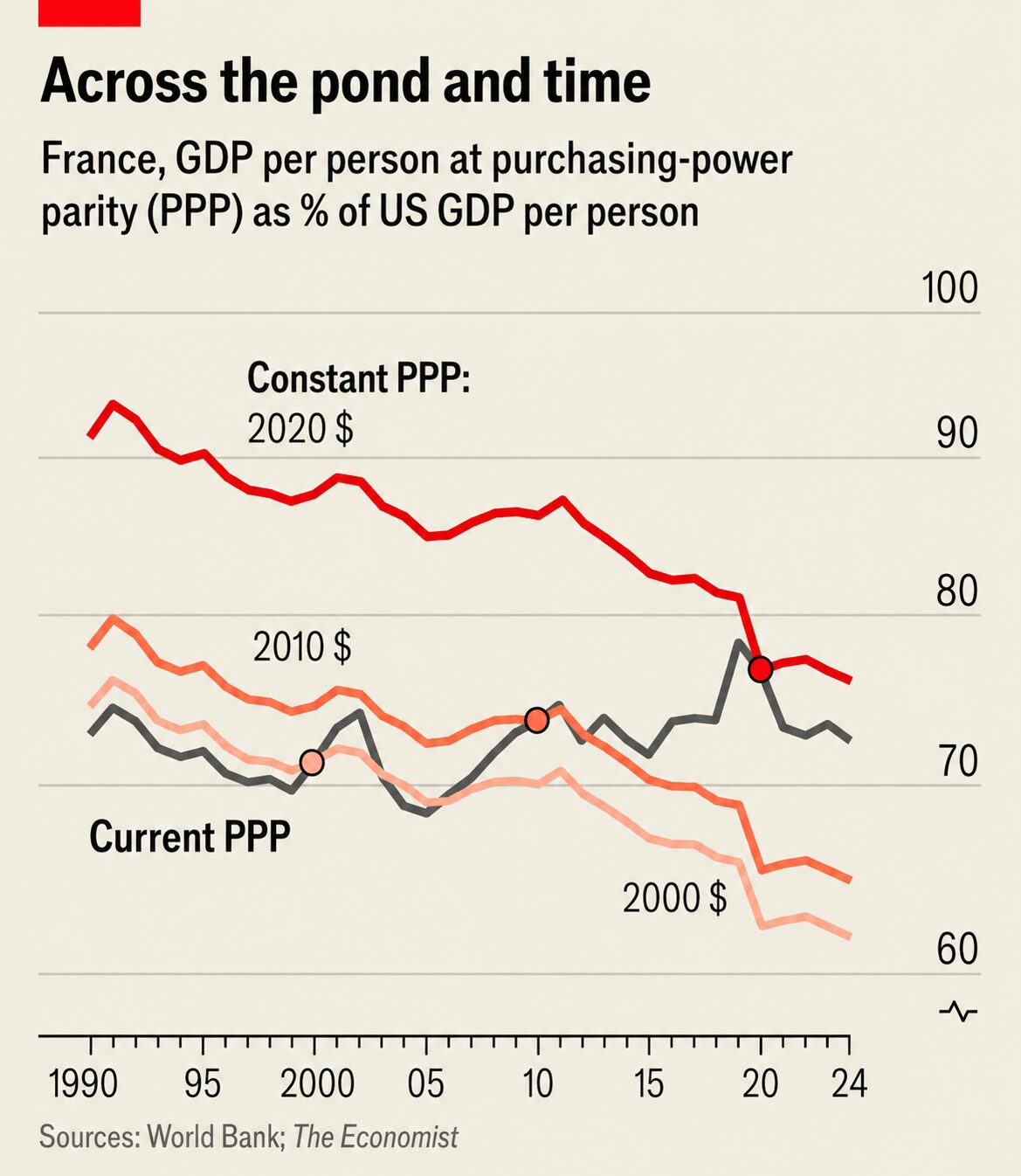
As The Economist just documented, earlier this year Nobel laureate Paul Krugman and several other elite economists got into a heated (and very wonky) online debate about whether Americans’ living standards really were zooming ahead of those of our European counterparts. The main point of contention was how to measure individuals’ purchasing power in both places, with one approach showing an increasing wealth gap and the other (Krugman’s) a relatively steady one. You can see the difference in the chart below: Using a constant “purchasing power parity” adjustment shows France’s GDP per capita—a standard way to measure individual wealth—to be declining versus that of the U.S., while using a “current PPP” adjustment shows little long term change, and thus a different wealth narrative.
As someone who loves both visiting foreign countries and returning home to my American creature comforts, I freely admit my biases in this debate. But both sides do raise some legitimate issues about how we should measure living standards across countries, as well as what should be measured. Overall, the debate has been delightfully intense and catty—at least for nerds like me.
Yet, as The Economist points out, both sides also seem to agree on a few things: First, Europe is growing more slowly than America, thanks in large part to the economic dynamism and tech-fueled productivity here. Second, even Krugman’s pro-Europe data (see chart above)—along with many other sources—show Americans to have higher average wages and more disposable income (yes, even after accounting for out-of-pocket healthcare costs) than the average European in most places (yes, there are exceptions), due to our superior labor productivity and their leisure choices. Third, and most importantly, both sides want to support their reading of the data with an “eye test”—i.e., visiting each place and just looking around—that the economists believe will confirm their own American/European wealth story.
Hilariously enough, thousands of European World Cup tourists—along with ones from Japan and other countries, too—have performed just that test, mere days after the economists proposed it. And the result is an absolute rout for Team America:
There are many reasons for the foreigners’ astonishment. (A big one, in my opinion, is that these folks are seeing parts of Real America, especially in the Sun Belt and Midwest, that foreign tourists rarely visit, yet—as we’ve discussed here repeatedly—allow not-rich Americans to live verycomfortable lives.) And, to be sure, not all the astonishment is genuine.
Another fascinating and wholesome part of the foreigners’ U.S. experience has been the outpouring of support they’ve received from both normie Americans—workers, neighbors, random passersby, etc.—and a wide range of American celebrities and companies. Most notable in this regard has been German soccer (fußball) fan Freddy, whose daily adventures in Middle America have earned him a giant online following and a Forrest Gump-like amount of in-kind support from pro sports teams, hotels, airlines, and a smattering of famous athletes, entertainers, and politicians (including at least one sitting governor who volunteered to help Freddy attend Germany’s game in Toronto after a flight cancellation). Freddy’s experience is unique, but only in terms of its magnitude: A wide range of U.S. businesses, municipalities, and influencers have rolled out the red carpet for these happy foreign visitors, greatly adding to the entire feel-good experience.
Unsurprisingly, this support has led dismissive cynics to explain that, actually, a lot of it is just a selfish attempt to boost sales, brands, and online engagement instead of genuine generosity and kindness. Some of those allegations are clearly false, but the correct ones are hardly worth complaining about. Instead, they evoke yet another lesson from Adam Smith: “It is not from the benevolence of the butcher, the brewer, or the baker, that we expect our dinner, but from their regard to their own interest.”
Scholars (ahem) often apply this quote to explain that “selfish” market transactions among free people are not only mutually beneficial but also can have broadersocial benefits and generate the wealth individuals need to perform charity (which Americans do a lot of, by the way). But Smith’s famous line also often applies to many “charitable” acts by corporations and celebrities: While maybe not motivated by pure altruism, these efforts are often a strategic effort to drive long-term profitability by improving brand reputation, attracting customers and workers, and generating more sales.
There’s little reason to view such motivation as unseemly. First, the act still makes people better off in some way (and often entertains and encourages onlookers, too), so who cares whether it was done for “benevolent” or “selfish” reasons? “Dinner,” in Smith’s terms, still gets served. Second, it’s usually impossible to say why these “charitable” people and firms decided to help Freddy (and any others in need)—and it’s usually a combination of both sympathy and self-interest/promotion. On the latter motivation, see point 1 and Smith above. On the former, check out his other book.
Tourism as a Massive US Services Export (And Source of “Soft Power”)
Admittedly, the World Cup visitor story isn’t all wine and roses, and there are—as noted—some less-optimistic policy lessons buried in here, too. For one thing, all these visitors are a stark reminder of the economic and geopolitical value of foreign tourism—and its recent, policy-driven decline here in America.
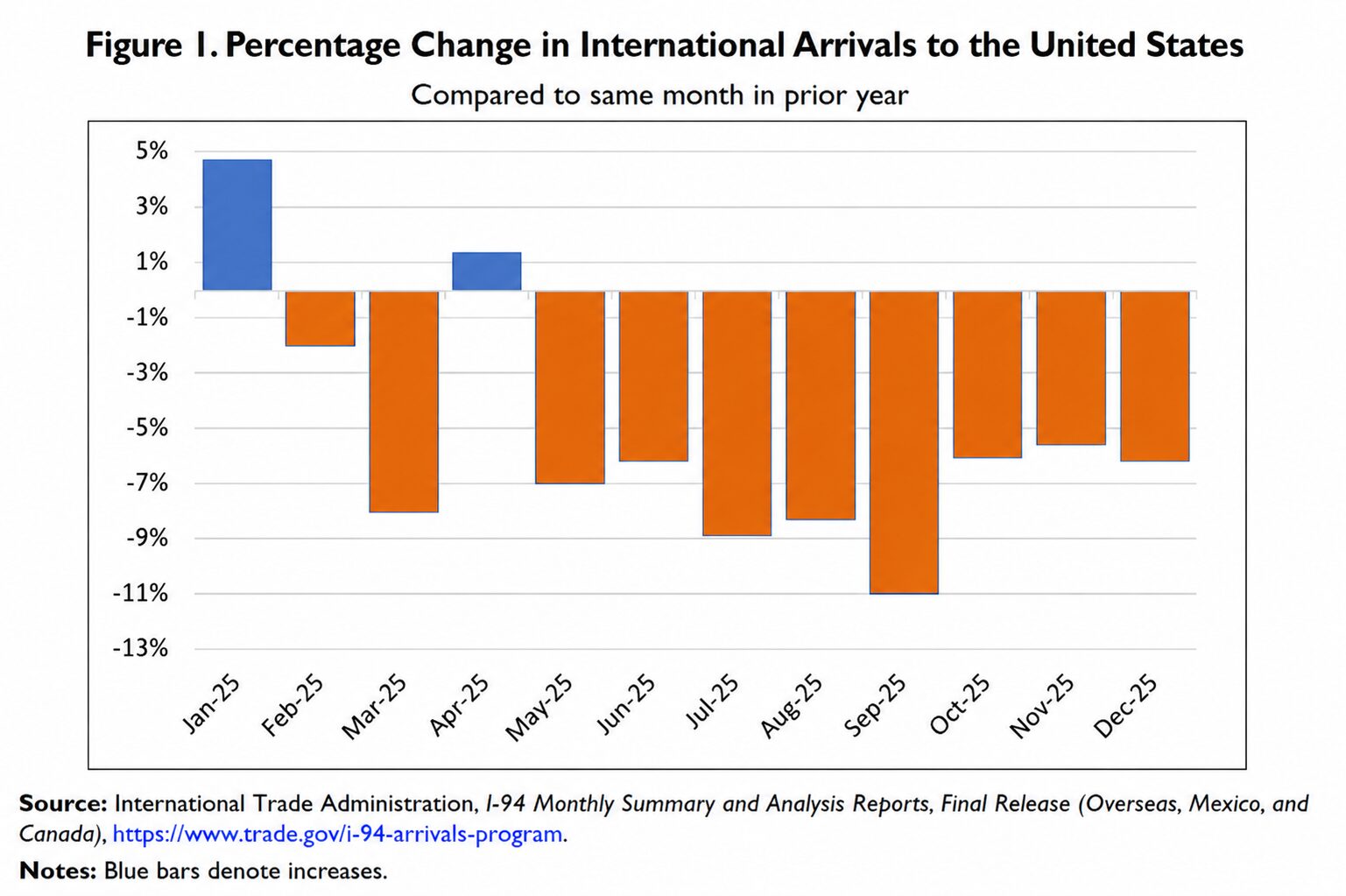
As we discussed last year, one of the more interesting and unfortunate results of Trump’s tariff wars, deportations, and related overseas antagonism (threatening to invade Greenland, calling Canada the “51st state,” etc.) has been foreigners’ independent retaliation against U.S. goods and services. And tourism—a U.S. services export—has been the trend’s most conspicuous victim. According to a May 2026 Congressional Research Service report, in fact, international visits were down in 10 of 12 months last year, with the only increases coming before Trump took office (January) and due to an abnormally late Easter (April):
This drop, in turn, hurt lots of American businesses and likely reduced U.S. economic growth last year by billions of dollars:
According to the U.S. Bureau of Economic Analysis, in 2023, travel and tourism (both domestic and international) accounted for approximately 3% of U.S. gross domestic product (GDP). According to the World Travel and Tourism Council (WTTC), a nonprofit organization that advocates for and researches global tourism, international visitor spending in the United States was approximately $176 billion in 2025, a 4.6% decrease from 2024. WTTC further noted that GDP for the travel and tourism sector increased 4.1% globally in 2025 from 2024 but grew 0.9% for the United States.
On the bright side, CRS goes on to note that the World Cup could boost foreign visits and GDP growth in 2026, and—judging from the packed bars/restaurants and sky-high prices for match tickets, airline fares, and hotel rooms—you can easily see why. Even with a few embarrassing visa-related snafus, the monthlong event has been going pretty smoothly so far and is forecast to attract almost 1.25 million international visitors, each expected to spend more than $5,000 (nearly twice the typical international tourist). None of that erases the roughly $12.5 billion in lost international visitor spending that WTTC projected for 2025, but it’s still a welcome rebound—especially for the smaller American businesses that depend heavily on foreign tourist spending each year.
The scenes of international comity surrounding the World Cup in 2026 are also a vivid, real-time reminder of how U.S. tourism is a market-based source of America’s “soft power,” improving the United States’ image abroad and advancing U.S. geopolitical objectives without spending taxpayer dollars (or doing stuff far worse than just that). Scholars call this the “contact hypothesis,” i.e., the notion that person-to-person encounters can affect overseas perceptions of a country in ways that no government messaging campaign or foreign aid package can match. World Cup visitors’ ecstatic consumption of everyday Americana is soft power in (mostly) organic form, with our culture, hospitality, and abundance doing the diplomatic work that American government officials can’t (or won’t) do.
To be clear, the goodwill America earns from Waffle House, Bass Pro Shops, Fenway Park—and the Americans who live and work near these and other iconic spots—doesn’t automatically translate into durable shifts in foreign acceptance of U.S. policy. But at a time when America’s global image has taken a few (ahem) hits, having a million-plus foreigners document their travels and return home as amateur American ambassadors is a welcome development, reminding people everywhere that the words of one guy in the Oval Office don’t represent a 350 million-person country.
The only question is whether the foreign tourism boost—and good vibes—can continue after the World Cup ends. The answer, unfortunately, will probably not be in Costco’s hands.
Seeing the Linkages Between Trade and Peace
Relatedly, all these good vibes are a nice reminder of one of the ways that trade—in this case both foreign tourism and global sports entertainment—can help encourage peace. As I documented in a 2020 paper, a wide body of research finds that heightened foreign trade can meaningfully reduce (but not eliminate) the chances of armed international conflict through several channels:
First, by making countries more commercially interdependent, trade encourages these nations to avoid war or other large-scale armed conflicts (which could impose substantial economic losses). Second, trade and commercial bargaining are more cost-effective than war as a means of resolving disputes with, or obtaining resources from, another country. Third, trade increases material prosperity (e.g., goods, services, investment, ideas) and promotes mutual tolerance and understanding. And fourth, free trade can limit the political power of domestic constituencies that may benefit from increased conflict.
Recent studies reinforce these conclusions. One finds a strong causal “peace dividend” from trade generally, i.e., that a doubling of bilateral trade reduces the probability of militarized conflict by roughly 30 percent. Elsewhere, a recent survey of almost 2,000 Japanese firms finds they routinely pushed for diplomatic solutions to supply-chain disruptions involving allies and adversaries alike—new support for the concept of “commercial peace,” i.e., that global businesses have powerful incentives to oppose wars that might harm their facilities (or, you know, kill their customers).
Regardless of the driver, however, the outcome is clear: While global economic integration can’t eliminate armed conflicts, policies that liberalize trade can make peace among nations more likely—especially when compared to the isolationist, antagonistic alternative the U.S. government is pursuing today.
In their modest but viral way, the million-plus foreigners now cheering in American bars are making a similar point.
A version of this article was published at The Dispatch on 6/25/2026.