
01 / 05
Autonomous Vehicles as the Next General-Purpose Technology

Blog Post | Motor Vehicles

Autonomous Vehicles as the Next General-Purpose Technology

Vehicle autonomy is likely to be the first mass application where AI becomes physical.

Summary: Autonomous vehicles are following the classic adoption path of a general-purpose technology — the same S-curve that steam, electricity, and the automobile once traced. If current growth rates hold, human driving has one to two decades left as an everyday activity. The payoff: reclaimed time, far fewer road deaths, cities rebuilt around people instead of parking, and a wave of new businesses made viable by cheaper transaction costs.


In 1939, five million people queued at New York’s World’s Fair to ride Futurama, General Motors’ model of America in 1960. Among the marvels were highways and mountain roads where cars, with no driver, whizzed their passengers across the country. Riders left wearing a pin: “I Have Seen the Future.” Sixty-six years later than General Motors expected, that driverless future is here.

The adoption of self-driving cars, also known as autonomous vehicles (AVs), is growing fast. In just two years, Waymo’s weekly paid rides are up tenfold to 500,000 across ten American cities. Using cameras, laser-based sensors (LiDAR), and machine learning trained on physical surroundings and movement, a new kind of car is outgrowing the human driver.

The industry calls today’s technology “Level 4” autonomy: self-driving with no need for human backup, but only within intensively mapped and geofenced areas. So far, no company has reached “Level 5” autonomy: a car that can self-drive wherever a human driver can. Yet, even without Level 5 autonomy, AV rides per week are ballooning. If that keeps up, the AV boom will soon rival the AI boom in scale and consequence, transforming transportation, cities, and the economy along the way.

That is what the arrival of a general-purpose technology looks like. It’s one of the main ways that capitalism keeps overhauling the human condition for the better. Lured by profit or chased by the fear of obsolescence, plenty of people and companies are working hard to bring human progress about. The rest of us will sit back and enjoy the ride.

On General-Purpose Technologies

Economists, starting with Bresnahan and Trajtenberg, call certain inventions “general-purpose technologies,” or GPTs. The name “ChatGPT” is a lucky mnemonic: while it actually stands for “Generative Pre-trained Transformer,” the pun is apt. AI is earning its place in the GPT list, alongside steam, steel, electricity, refrigeration, the internal combustion engine, telecommunications, the automobile, mass production, the transistor, the computer, the internet, and the smartphone. AVs may be next GPT.

GPTs stand out for being transformative, not merely additive. They spawn new infrastructure, chart-topping companies, redraw human geography, create and destroy whole occupations, define eras of macroeconomic history, and accelerate productivity. The key is that a GPT becomes a hub that almost every supply chain runs through. It gets built into existing supply chains and spins off new ones, ending in new downstream products. Some GPTs reach mass consumer adoption in the home too.

Today, AI is transforming office work, but its victories are in bits rather than atoms, in data rather than stuff. Vehicle autonomy is likely the first mass application where AI becomes physical.

The AV S-Curve

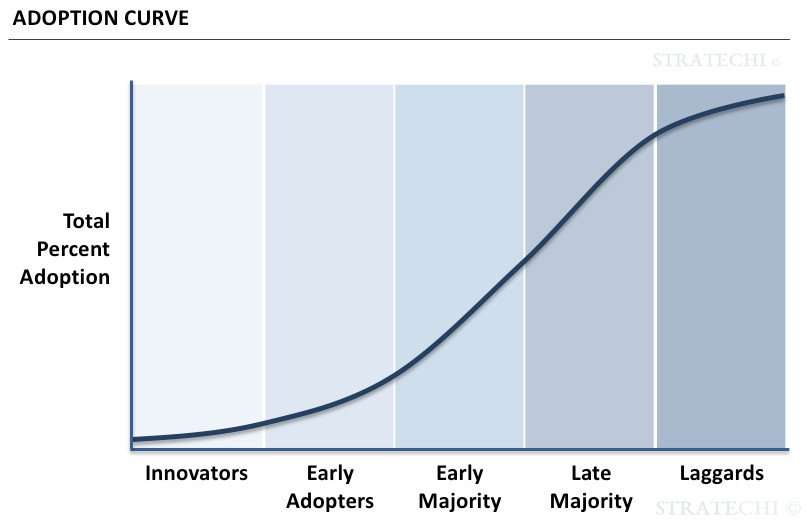
Extrapolation is a good way to forecast the future. Extrapolate a fast growth rate, and you get exponential acceleration. Moore’s Law, the rule of thumb that computer power roughly doubles every two years while costs drop, is the classic example of exponential acceleration: it persisted for decades, expanding computing power in a way few initially predicted. But exponential growth doesn’t last forever. For new technologies, it eventually levels off, tracing an “S-curve”: flat, then steep, then flat again, as in Figure 1:

Figure 1: The Adoption S-Curve
Source: stratechi.com/adoption-curves/

Figure 2 shows adoption patterns for specific technologies among US households:

Figure 2: Technology Adoption in US Households, Percent

In Figure 2, the steep part of the adoption curves is when a new technology transforms the human experience and the economy. AI is on the steep part now, with its computing power and the volume of data it processes growing more than fivefold a year. And AVs might achieve that growth rate soon.

Waymo, the market leader, runs about half a million paid robotaxi rides a week across ten U.S. cities — up from roughly 10,000 a week in 2023. They are targeting a million rides a week by the end of 2026, with expansions into Tokyo and London next. From spring 2024 to spring 2025, rides per week increased fivefold. From spring 2025 to spring 2026, they roughly doubled— a slowdown widely attributed to a limited supply of vehicles, not waning demand. With almost every car ride in the world still human-driven, there is lots of room for annual growth to keep doubling or even increasing fivefold.

Project that growth forward and the math becomes mind-boggling.

A million rides a week sounds big, but there are around 1.4 billion cars on the world’s roads. If global travel trends mirror American habits of around 1.9 trips per vehicle a day (number of vehicle-trips divided by number of vehicles), that implies upwards of 18.6 billion personal car rides worldwide every week, maybe 20 billion once commercial trips are factored in. That means AV trips currently account for a fraction of one percent. At fivefold annual growth, a million becomes 5 million by end-2027 and 125 million by end-2029, still under one percent. AVs won’t reach mass adoption this decade.

But keep that fivefold growth going, and AVs hit the steep part of the S-curve and 3 billion rides a week by the end of 2031. A year or two later, they would account for most rides worldwide. Even at a mere doubling per year, the takeoff arrives by the late 2030s.

On present trends, driving has one to two decades left as an ordinary part of life. Most of us will live to see it sunset.

The Driverless Revolution

The coming AV revolution is exciting. Start with time. Americans spend about an hour a day behind the wheel, one of their least favorite times of day. With eyes off the road, this time becomes phone calls, reading, movies, work, or sleep. It should save lives too, as algorithms and infrastructure keep improving in ways human reflexes can’t. Road crashes, with human error being the critical reason for 90%+ of them, kill some 1.16 million people a year and are the leading cause of death for those aged 5 to 29.

Urban planners will get millions of acres of downtown parking to repurpose as AVs park themselves somewhere cheaper or move on to the next fare. Children, the elderly, the disabled, and the undocumented all become more mobile. Eventually, traffic lights will vanish as cars communicate with each other, making brake lights and turn signals obsolete.

Household budgets will become simpler as car ownership becomes optional. Expect mobility to become a service, where you summon the vehicle that fits the trip. That will breed more specialized vehicles: one-seaters for solo trips, cargo haulers, sleeper cabins that compete with short flights.

Some jobs, especially long-haul trucking and ride-hail driving, will disappear, but the same shift will ease the work of anyone who drives between appointments, from plumbers to real estate agents to music teachers. Their road time will become fun and/or productive, and access to those jobs will widen because driving will no longer be required. Expect more home health aides, babysitters, house cleaners, landscapers, and domestic services generally.

Without human driver wages, last-mile delivery will become cheap enough to overhaul traditional retail and reduce brick-and-mortar market share. Picture a store sending your order in a refrigerated pod that keeps the ice cream hard. You get a notification as the robot-on-wheels opens your garage with a one-time code and starts loading your fridge. A micro-AV takes a service elevator and goes fifty floors up.

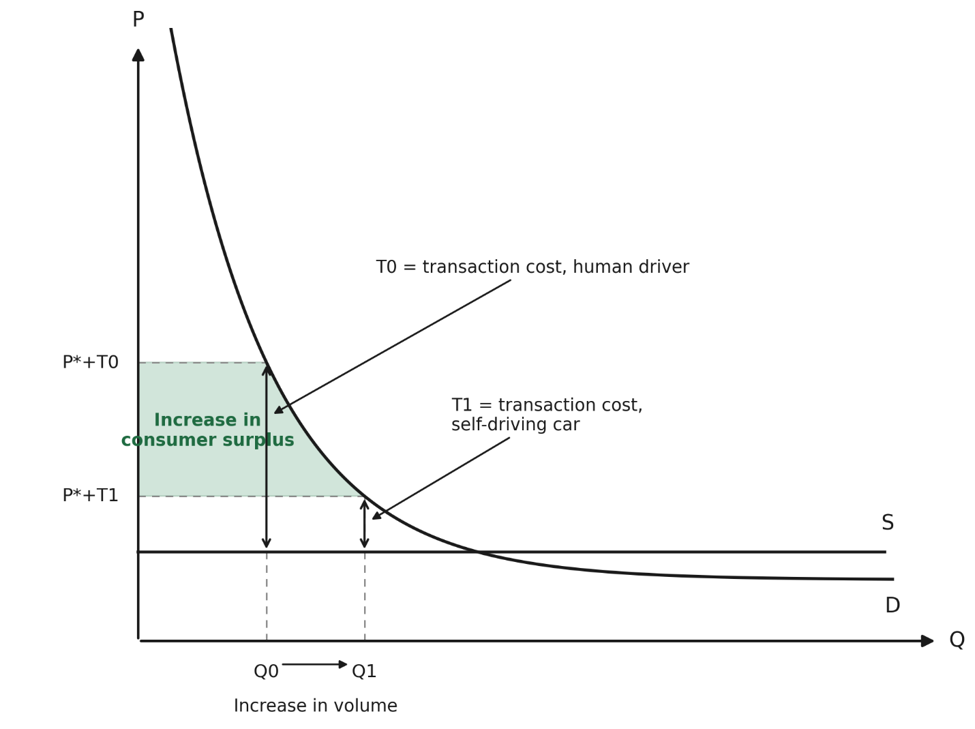
The larger pattern, as economist Xiaokai Yang showed, is that economies grow through greater specialization and variety when transaction costs, the hassle and expense of getting buyers and sellers together and of contracting and shipping, fall. AVs are poised to become a prime technology that reduces transaction costs, enabling a boom in small-scale local trade because “come pick it up” will no longer mean an hour in traffic. Figure 3 shows how falling transaction costs will let many businesses, from restaurant takeout to device repair, charge less and sell more.

Figure 3: How AVs Will Boost Business
Even more interesting are the new businesses that are uneconomic right now, but that AVs will make viable. Figure 4 shows why:

Figure 4: How AVs Make New Businesses Possible
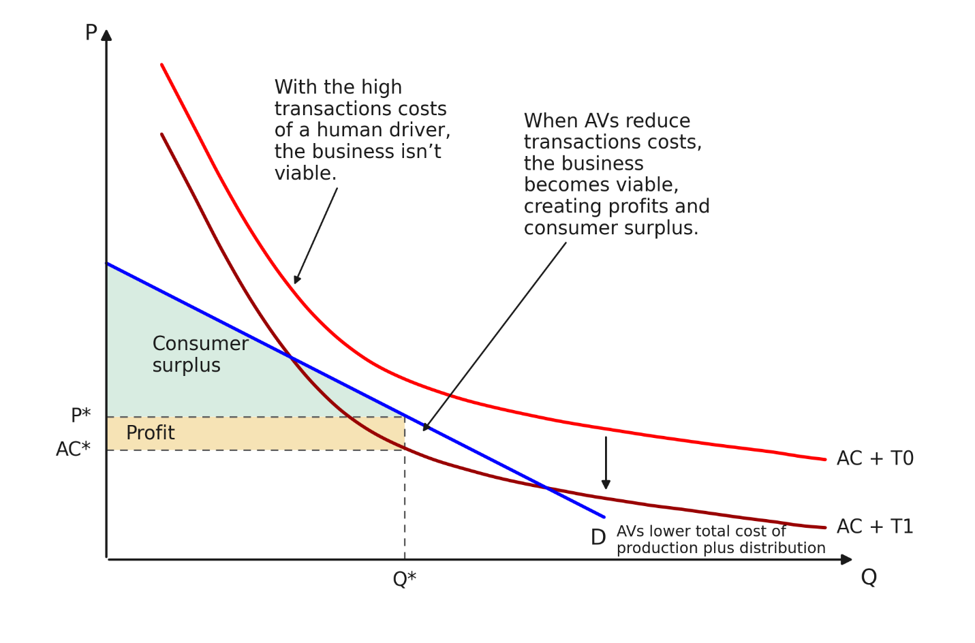
Most businesses can produce more cheaply as they grow, because fixed costs are spread across more sales. If what consumers are willing to pay is less than the average cost, the business folds, or never begins. By reducing transaction costs, AVs will flip some businesses from uneconomic to viable. Think of home kitchens offering takeout, new community farms, an artistic home tinkerer with a 3D printer, and things you never imagined. That’s where AVs will really earn their spurs as a GPT.

Freedom in the Robotaxi Age

For a century, freedom of movement has meant holding a license and keeping a machine in the driveway. Cheap driverless rides extend a freedom many of us take for granted to teenagers, the elderly, the disabled, and many others. But a self-coordinating traffic network could also become a system that knows where everyone went and when, so early safeguards against mass AV surveillance are important.

Steam, electricity, and the automobile gave ordinary people options their grandparents could not have bought, no matter the price. The robots taking the wheel are the next installment. Let them drive.
Blog Post | Progress Studies

Agency and the Making of History | Podcast Highlights

Psychologist Martin Seligman argues that belief in human agency has been a powerful driver of innovation and human progress.

Listen to the podcast or read the full transcript here.

Adam Omary: I’m Adam Omary, a research fellow at HumanProgress.org. I’m honored to be joined by Dr. Martin Seligman, director of the Positive Psychology Center at the University of Pennsylvania. Dr. Seligman is widely credited with founding the modern positive psychology movement and has been called by my graduate advisor, Steven Pinker, “perhaps the world’s greatest living psychologist.” He’s the author of many books, including, most recently, Agency: The Psychological History of Human Progress, which we’ll be speaking about today.

I’m also joined by my colleague, Johan Norberg, a senior fellow in the Center for Global Liberty and Prosperity at the Cato Institute and a historian of human progress.

Being a psychologist myself, I plan to discuss agency with Dr. Seligman from the psychological perspective, and Johan will discuss human progress from the historical perspective. Before we start our panel, Dr. Seligman, I’d love to hear an overview of the book from you.

I’m trying to found a new field, Adam, the field that Isaac Asimov called psychohistory. And it has two aims: to show that psychological states profoundly influence historical events, and then to use what we know about history to try to predict the future. And the psychological state I deal with in this book is agency.

Agency for me has three components. The first is efficacy, the belief that you can accomplish your goal. Optimism, the belief that you can do this into the distant future. And imagination, the range of goals that you can possibly achieve. And the historical hypothesis is that progress and innovation occur when civilizations believe in human agency, and when that belief is absent, we see stagnation and regression. The book culminates with AI. Is AI going to destroy us, or is it the most technologically important aid to human agency of my lifetime? I believe the latter.

Adam Omary: I’m excited to get to AI, but I want to begin with conceptions of progress. As you describe in Agency, and as we outline with data on HumanProgress.org, we’re living in the most extraordinary time of human history. We’re wealthier and freer. Lifespan is longer than ever. Disease and mortality rates are falling. And yet, despite these improvements, so many people seem pessimistic about the future. Why is that?

I think there are at least two answers. One is ideological. It’s become beneficial politically to argue that we’re in one crisis after another, and that only I, the political candidate, can solve that crisis. And the other is journalism. A hundred years ago, if you were a farmer in Nebraska, you might find out a month later that the Titanic went down. Right now, if you watch CNN all day long, you’re going to hear about one horrible thing after another. If it bleeds, it leads. So I think that political ideology and journalism are two of the factors that lead people to believe that progress is a myth.

Johan Norberg: I thank you for this incredibly important book. I recommend it to everyone. I think you’ve documented the rise and fall in the belief in human agency throughout history very well. But societies with a widespread belief in human agency, such as ancient Athens, Renaissance Italy, the Dutch Republic, Britain after the Glorious Revolution, and the American Experiment, also had other things in common. They were, compared to other contemporary civilizations, relatively free and open, and had relatively limited governments. And I have yet to find one example of a very despotic, regimented society with high levels of agency.

So, is agency really the independent variable, or might it be that agency is what we observe when people are more or less liberated and have the incentives to create, adapt, and change?

Great question.

I want to speculate about the relationship between freedom and agency. Freedom is a fact about the world, and agency is a belief about oneself. Now, when we live in a relatively free world, technology advances, science advances, literature gets better, quality of life gets better, more progress occurs, and that impacts agency itself. That is, it makes you believe you can do more, and if you believe you can do more, that produces more freedom in the world. So I think the relationship is reciprocal. Agency increases freedom, and freedom increases agency.

Adam Omary: Dr. Seligman, you’re famous for your work on learned helplessness, which is essentially the opposite of agency. Again, paradoxically, despite living in the freest and most prosperous time in history, we see a lot of this learned helplessness, especially among young people and especially on social media. Do you worry that certain cultural trends are reducing our sense of agency?

Victimology really gets in the way of agency. So learned helplessness is the belief that nothing I do matters. And quite a lot of ideology about why suffering occurs in the world, why inequality occurs in the world, very easily leads to the belief that you’re a victim of a malign environment or a malign system. Under that assumption, when things go wrong and when we suffer, it’s not because of our character or our decisions or actions; it’s because we’re victims.

Adam Omary: From an evolutionary perspective, it seems strange that people could even have learned helplessness. Could it be what social psychologist Rob Henderson calls a luxury belief? In other words, only in a society that is prosperous enough for one to get away with learned helplessness can we see that type of mindset evolve?

No, I wouldn’t go that far. Learned helplessness is not only quite real in the laboratory and in real life, but over the last 25 years, my colleague Steve Maier, who died recently, was able to trace out the brain circuitry for learned helplessness. And to simplify it, there is a structure in the human brain called the dorsal raphe nucleus. And when it fires, that’s when you see passivity and giving up. That seems to be the default response to bad events. However, when we learn hope and mastery, that triggers a set of circuits in the forebrain which inhibit the dorsal raphe nucleus. So helplessness is a very real phenomenon, and if it’s not inhibited by hope, it leads to profound passivity, cognitive deficits, poor health, and premature death.

Johan Norberg: Why is that? What’s the evolutionary benefit of giving up?

Well, if you’re a reptile or a bird and a predator jumps on top of you, you don’t have a lot of cognitive mechanisms to deal with it. And by curling into a ball and giving up, you conserve energy. As mammals, we’ve inherited underneath our frontal cortex a set of biological mechanisms that incline us to give up. And it requires a belief in agency, a belief in hope, an experience of mastery and coping to turn off that reptilian tendency.

Johan Norberg: You also have a wonderful way of explaining our negativity bias. You write that we inherited a bad weather brain. Our ancestors who were anxiously looking towards the horizon for bad weather or predators probably survived and passed their stressed-out genes to us, so we pay more attention to what’s bad than what’s good. On the other hand, you also document that political candidates who are more hopeful and optimistic about the future usually win.

Why is it that we want bad news but hopeful politicians?

Another good question. Let’s see if we can make sense of it.

So first, there is a negativity bias, and it comes from our ancestors in the Ice Ages. Pessimism comes naturally to us. And we are attracted to optimism, empirically. I could run an experiment where I give you a speech to deliver on the telephone, either in a highly depressive cadence or in a very chirpy cadence. Just wait to see how long it takes for people to hang up on you during your depressed speech. Misery loves company, but company does not like misery. We’re attracted to optimistic people. I’m not sure I can say more deeply why.

Politically, this also seems to be the case, at least in American elections. We’ve looked at the last 120 years of elections, and for the most part, the more optimistic candidate wins. We looked deeply at that in the Trump-Harris election. You might think that Trump was the more pessimistic candidate. He was the darker candidate. He cites four times as many bad events as Harris. But we decided to look at how he explains those bad events versus Harris, and we tracked this throughout the campaign. During the first debate, Trump and Harris are equally pessimistic, and Trump cites more bad events. But right through October 31st, Trump gets more and more optimistic. And by the end, he’s massively more optimistic than Harris. And we put our prediction about the election in a sealed envelope, and we sent it to our reporter friends, and we predicted a Trump victory. So humans like optimists, and we want to be led by them.

Adam Omary: How do you distinguish agency from ambition? What does high agency look like in an individual who chooses to live a quiet life centered on family?

Good question. I’ve never been asked this before, so I’m winging it.

So the first component of agency is that you believe that your actions will produce results. Well, to be ambitious, you’d have to have that. To be agentic, you also have to believe that you can succeed at your goals in the far future. And again, to be ambitious, you have to believe that as well. And thirdly, to be agentic, you have to entertain a large range of possible goals. And being ambitious, merely desiring fame and fortune, by no means guarantees imagination. So that’s the difference. Ambition is shallow.

Johan Norberg: One thing that keeps me awake at night is the problem that you write about: pessimism and despair seem to be self-fulfilling. If you think that there’s nothing to be gained from trying, you don’t try. Similarly, if people don’t understand that objective indicators of living standards are improving, that could undermine progress.

Can you talk to us about the importance of understanding past progress for agency and for human flourishing?

It’s crucial to believe in human progress. I’m in a constant struggle with my English department and my history department at the University of Pennsylvania, both of which are pervaded by the belief that human progress is a myth. And the cost of not believing in human progress is not trying. The cost of alarmist pessimism, for example, about the climate, is not trying to do something about the climate.

For me, this has to do with education. We have to teach history differently. Human history is not just the history of victims and suffering; it’s the history of the rise from illiteracy, poverty, and death to literacy, wealth, and long lives. There’s been a huge increase in human well-being, measured by any objective measure of human well-being I know. And the measures that defy that trend are measures of depression and pessimism. And that’s one way of naming, Johan, the problem with misteaching the history of the world.

Adam Omary: Dr. Seligman, you began this conversation by pointing towards artificial intelligence as the next major step of human progress. Artificial intelligence increasingly allows us to delegate decisions and tasks that once required our own knowledge and effort. When does that delegation expand our freedom, and when does it weaken our confidence or ability to act for ourselves?

I am delighted to address that question. I deal with Claude and ChatGPT roughly six hours a day. In fact, I’m so excited by them, I feel like I’m 21 again. Let me give you two examples from my life in which AI hugely expands my own agency.

AI has produced more love in my life, contrary to those who say it’s dehumanizing. I have two four-year-old grandsons, Denny and Max. I’m 80 years older than they are, and I noticed, starting at around age two, that I was becoming invisible to them. They walk faster than I can run. I can’t throw a football around with them. So I went to Claude and to Chat, and I said, “Help me write stories in which Max and Denny are the guardians of the world and the heroes.” And now I’m on volume six, chapter 24: Max and Denny tour the solar system. Well, I’m visible to them now. I have more love in my life.

Number two, and much more importantly, AI has increased my own creativity. Let me just give you one example of a discovery that I made with Claude that no human being could have made. This is the paradox of the Axial Age. Across the globe, around 1000 BCE, Greece, Israel, Persia, India, and China were backwaters: villages, illiteracy, minimal technology, etc. Five hundred years later, all of those cultures are thriving. What happened during those 500 years across the globe?

Well, I had a hypothesis, and that was that they invented new words. They conceived, for the first time in human history, words about human agency, as opposed to divine agency. Well, interesting hypothesis, but I knew no human being could test it. There’s no human being who knows ancient Sanskrit, ancient Persian, ancient Chinese, ancient Hebrew, and ancient Greek. But Claude and ChatGPT do. So I gave them a hypothesis. We worked for a day together, and sure enough, the words don’t exist or barely exist in the five cultures in 1000 BCE, but by 500 BCE, they’ve invented the words.

So, for example, in Hebrew, the word teshuva is invented. It’s not in the Torah. It’s invented later on. Teshuva means repentance. It means you can actually do things to change your life. And once you have new words, new things can occur. Take sexual harassment, for example. People were harassed sexually in the office for generations, but there was no word for it until about 1970. Once there was a word for it, it opened up lawsuits, mandatory training, and ways of counteracting it. So when we have new words, we invent new things. And that’s an example in which AI made a discovery that could not have been made by human beings.

Adam Omary: There is some concern that, if we are having agents think for us, particularly for young students, it will harm our own ability to think. Do you think of agency like a muscle? Certainly it can be developed, but is it also a matter of ‘use it or lose it’?

That is one doomsayer hypothetical I agree with. They call it de-skilling. Let’s take writing. So I’ve been writing for 70 years. I’ve made hundreds of thousands of decisions between “perhaps” and “maybe.” And so at age 84, I’ve got the skill of writing, and I’m delighted to have Claude, who writes better than I do, help me along and edit. It’s not de-skilling me. But if, starting at age six, I have my writing done by the machines, I’m never going to learn how to write.

Adam Omary: Another audience question. How do different philosophical ideas, such as religious versus secular worldviews and individualist versus collectivist ethics, drive the cultural adoption or rejection of agency?

Let me give two examples.

I’ll start with the obvious Marxist one. Believing that history unfolds as a result of historical forces that are beyond our control is a recipe for passivity. And it suggests that Marxism is an ideology that leads to passivity, a sense of victimhood, and a lack of progress.

In terms of religion, I spent a lot of the book documenting different religious views. Let’s take early Catholicism and early Christianity before Augustine. So early Christianity after Jesus, up to about 300 AD, is very optimistic. You can become holy, and in fact, your encounter with God after you die is about, “Did you do the things that would make you acceptable for salvation?” Under that kind of belief, you get agentic action. Then Augustine comes along and says, “Hold it, that’s Pelagianism.” Pelagius believes that you can contribute to your own grace. Augustine says that’s nonsense. Any time you do something good, it’s only by the grace of God.

That’s the opening gate for the stagnation of the Middle Ages. Then, after the Renaissance, Catholicism once again becomes highly agentic. Erasmus argues that we’re like toddlers. When we fall down, God lifts us up, but we have to have motive power of our own to be so lifted. Luther says that’s nonsense, and in his retort to Erasmus on the bondage of the will, he tells us about predestination, about the lack of human will, and Calvin even goes further. With the Restoration and the influence of Arminian Protestantism, which believes you have to assent to grace, progress gets resuscitated.

So, that’s a long-winded way of saying that your ideology and religious faith modulate your agency, and most importantly, the achievement of entire cultures.

The Human Progress Podcast | Ep. 86

Martin Seligman: Agency and the Making of History

Psychologist Martin Seligman argues that belief in human agency has been a powerful driver of innovation and progress.

Anthropic | Scientific Research

AI Finds a New Enzyme System in a Virus

“Many discoveries that have revolutionized biology and medicine started with a scientist noticing something odd in the staggering diversity of molecular machines found in nature. Restriction enzymes, proteins that cut DNA at specific short sequences, were found in bacterial immune systems, where they destroy the DNA of invading viruses. Researchers realized they could use these enzymes to cut DNA at chosen places and splice genes from one organism into another, which launched the biotechnology industry. Taq polymerase, an enzyme that copies DNA at high temperatures, was identified in a bacterium in a Yellowstone hot spring. It became the basis for PCR, the DNA-copying method used in much of modern diagnostics. CRISPR was first noticed as an unusual repeat sequence in the DNA of certain bacteria, and is now the foundation of gene editing-based medicines.

In the spring of 2026, we formed a research group to see whether general AI models can systematize and accelerate such discoveries. We believe that this acceleration will come from establishing a new way of doing biology research, in which agents collaborate with humans in every step of the process. Developing this new way of working required that we build our own lab and a single team working on everything from training Claude in biology to running experiments in the lab.

Today, we’re sharing early results from one of our first research programs, in which Claude autonomously discovered a novel enzyme system that is associated with an array of DNA repeats, a pattern reminiscent of CRISPR. Although we don’t yet know its function, the system that Claude discovered has a set of characteristics that have only ever been found together in a handful of other systems, all of which are programmable and perform operations like cutting, copying, and pasting DNA. Beyond CRISPR, which has already transformed science and medicine, several other such systems are now in development as promising tools.

The system that Claude found is based on a reverse transcriptase (RT), enzymes that copy RNA into DNA. While this underlying RT, found in a jumbo phage, had been identified in previous studies, Claude appears to be the first to notice the system’s defining features—an associated array of non-coding DNA sequences and an additional accessory protein of unknown function.”

From Anthropic.

The Keyword | Computing

Google Expands SynthID Detector for AI content

“As AI tools become better and easier to use, having clear context about the content you encounter online helps you make informed decisions about what to trust. Since launching Google SynthID in 2023, we've helped people identify AI-generated media using imperceptible watermarks across images, video, and audio. To date, we've watermarked over 180 billion images and videos, along with 240,000 years of audio content.

Last year, we introduced an early version of the SynthID Detector to help media professionals verify AI-generated content. Now, we’re expanding access to everyone – with the tool available globally in English starting today.

With the new SynthID Detector, anyone can easily check if an image, video, or audio file was made with AI from Google or our partners, including OpenAI, NVIDIA, Kakao, and soon, Apple.”

From The Keyword.