01 / 05
A Feast of Human Progress and Abundance

Blog Post | Human Development

A Feast of Human Progress and Abundance

Let’s give thanks for how far we’ve come since the time of the Pilgrims.

Summary: A family group chat about Thanksgiving dinner reflects centuries of extraordinary advancement. The same journey that once separated families by months can now be made in hours. A meal that was once a rare luxury has become highly affordable. From instant communication to abundant food, everyday conveniences serve as a reminder that human ingenuity has transformed hardship into prosperity.


Two weeks before Thanksgiving, my sister sent a link to our family group chat. It wasn’t an RSVP form; it was closer to an online wedding gift registry. All the Thanksgiving classic foodstuffs were on the list—turkey, honey baked ham, mashed potatoes, gravy, stuffing, cranberry sauce, candied yams, green bean casserole, pumpkin pie, and more—each with a sign-up slot to commit to bringing the goods. This brief interaction represented numerous aspects of human progress, and I paused to take it in with awe and gratitude.

For one, I live in Boston, not far from where the original Thanksgiving Pilgrims settled in Plymouth, while my family lives in Los Angeles. The distance between us is almost identical to the distance between Britain and the New World, roughly 3,000 miles across land instead of ocean. Yet, the majority of Pilgrims never returned home and never even had the opportunity to stay in contact with the world they left behind. A letter across the Atlantic would cost days’ worth of wages and take months to arrive, if it found safe passage at all.

By the time the first Americans began settling in California in the 1840s, locomotives and the telegraph had been invented, but no transcontinental systems had yet been established. Most westward settlers knew they were signing up for a one-way journey taking many months, with high rates of death and disease. If they could maintain any contact with family on the other side of the continent, messages would take weeks via stagecoach. Even the extraordinarily speedy and expensive Pony Express system—with riders galloping nonstop at full speed, exchanging horses every 10-15 miles, and exchanging riders once or twice a day—still took 10 days to deliver messages across the country.

By the time the first transcontinental telegraph line was established in 1861, messages took minutes rather than weeks but were extraordinarily expensive—nearly a day’s average wage per word. Messages had to be brief and were largely reserved for the government, the military, and the ultra-wealthy. However, a decade later, the first transcontinental railroad was established, which, with the adoption of standardized domestic postage, meant most Americans could afford to send letters across the country and have them arrive within a week. Travel between Los Angeles and Boston became possible but still took weeks and cost several weeks’ worth of average wages.

Innovation accelerated even more rapidly during the 20th century with the invention and commercialization of telephones and air travel. By 1950, the luxuries of traveling between coasts in six hours and communicating across coasts in real time became possible. But these new services were still extraordinarily expensive. Transcontinental flights, both then and now, cost around $300; however, adjusted for inflation, a $300 flight in 1950 corresponds to well over $3,000 in today’s dollars. Likewise, while modern phone plans offer unlimited texts and calls for the equivalent of a few hours of the average minimum wage per month, transcontinental phone calls in the 1950s cost over $2.00 per minute, or over $27 per minute in today’s dollars. Only in the last 30 years, thanks to the economic engine of progress, did it become affordable for the average American to call long-distance for hours.

The technologies enabling long-distance communication and travel have improved immeasurably from the time of the Pilgrims.  That alone is reason enough to be thankful. But besides the amazing pocket-sized supercomputers and the satellite infrastructure that made my family’s group message possible, our exchange hinted at another amazing development that people often take for granted: food abundance.

My father grew up in a small Palestinian village in northern Israel, where most people were farmers. He was one of nine siblings and told stories of how chickens were slaughtered only on special occasions—red meat even rarer. A single bird was shared among a dozen people. “You were lucky if you got a drumstick,” my father said. Everything from feeding to slaughtering and plucking was done by hand. And without refrigeration, the meal had to be eaten at once.

By contrast, in the United States today, food is so cheap and plentiful that several relatives can volunteer to bring a whole turkey. At my local supermarket, frozen birds were recently on sale for $0.47 per pound. A 15-pound turkey, enough to feed a family, costs less than an hour’s minimum wage.

I am grateful for the world of superabundance, which has improved our lives and Thanksgiving holidays beyond what our ancestors could have dreamed. The fact that these interactions are commonplace enough to be taken for granted—communicating in real time across vast distances, flying across the country or around the world in hours, earning enough calories with a day’s wages to feed a family for a week—make our story of progress all the better.

This Thanksgiving, take a moment to consider how life has improved since the time of the Pilgrims. The food on your plate, the technology in your pocket, and the family who traveled long distances to be at the table were all made possible thanks to generations of compounding progress.

Reuters | Food Prices

UK Food Inflation Falls Despite Energy Shock

“Britain's food industry warned in February that soaring energy costs following U.S. and Israeli strikes on Iran could push food price inflation towards 10% by Christmas.

Six months later, food ​inflation has instead fallen to a near two-year low, as fierce supermarket competition, consumers' resistance to further price rises and better hedging by suppliers helped absorb ‌the shock.”

From Reuters.

Blog Post | Food Prices

Time Pricing the Fourth of July Cookout

Independence and abundance.

Summary: The dollar price of a traditional Fourth of July cookout has increased since 2016, but rising wages have more than offset those higher prices. As a result, Americans spend less time working to earn this year’s Independence Day meal than they did a decade ago. Measured in time rather than dollars, the data show that abundance has continued to grow as the population has increased.


Every year, the American Farm Bureau Federation estimates the cost of a traditional Independence Day cookout. The basket includes summer cookout staples such as cheeseburgers, chicken breasts, pork chops, potato chips, pork and beans, fresh strawberries, homemade potato salad ingredients, fresh-squeezed lemonade ingredients, chocolate chip cookies, and ice cream.

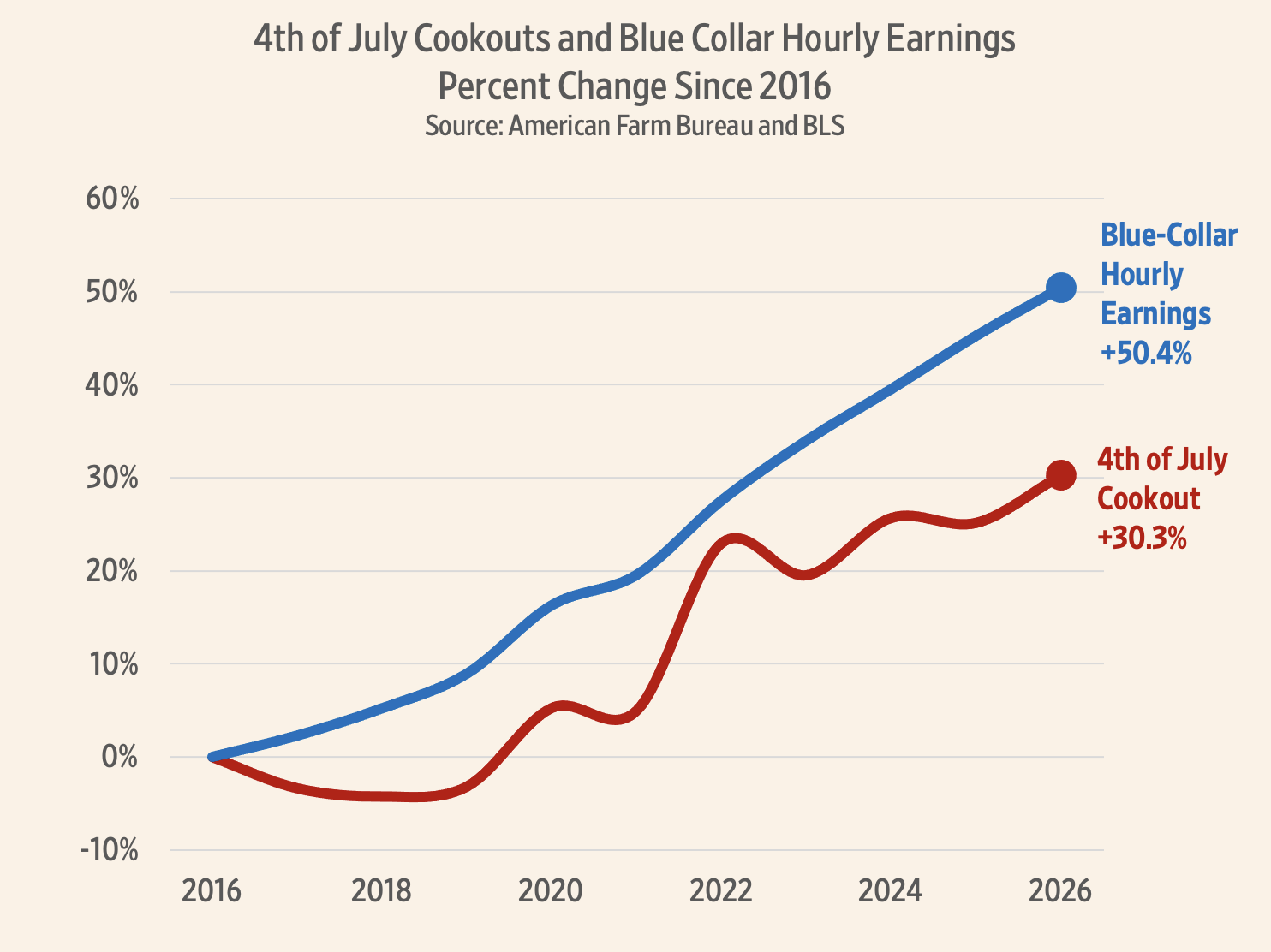
Since 2016, the dollar cost of this basket has risen 30.3 percent, from $56.67 to $73.82. At first glance, that suggests celebrating the Fourth of July has become significantly more expensive.

But money prices tell only half of the story. The real question is not how many dollars the meal costs, but how much time people must work to earn those dollars. Since 2016, blue-collar worker hourly earnings increased 50.4 percent, from $21.48 to $32.31 per hour.

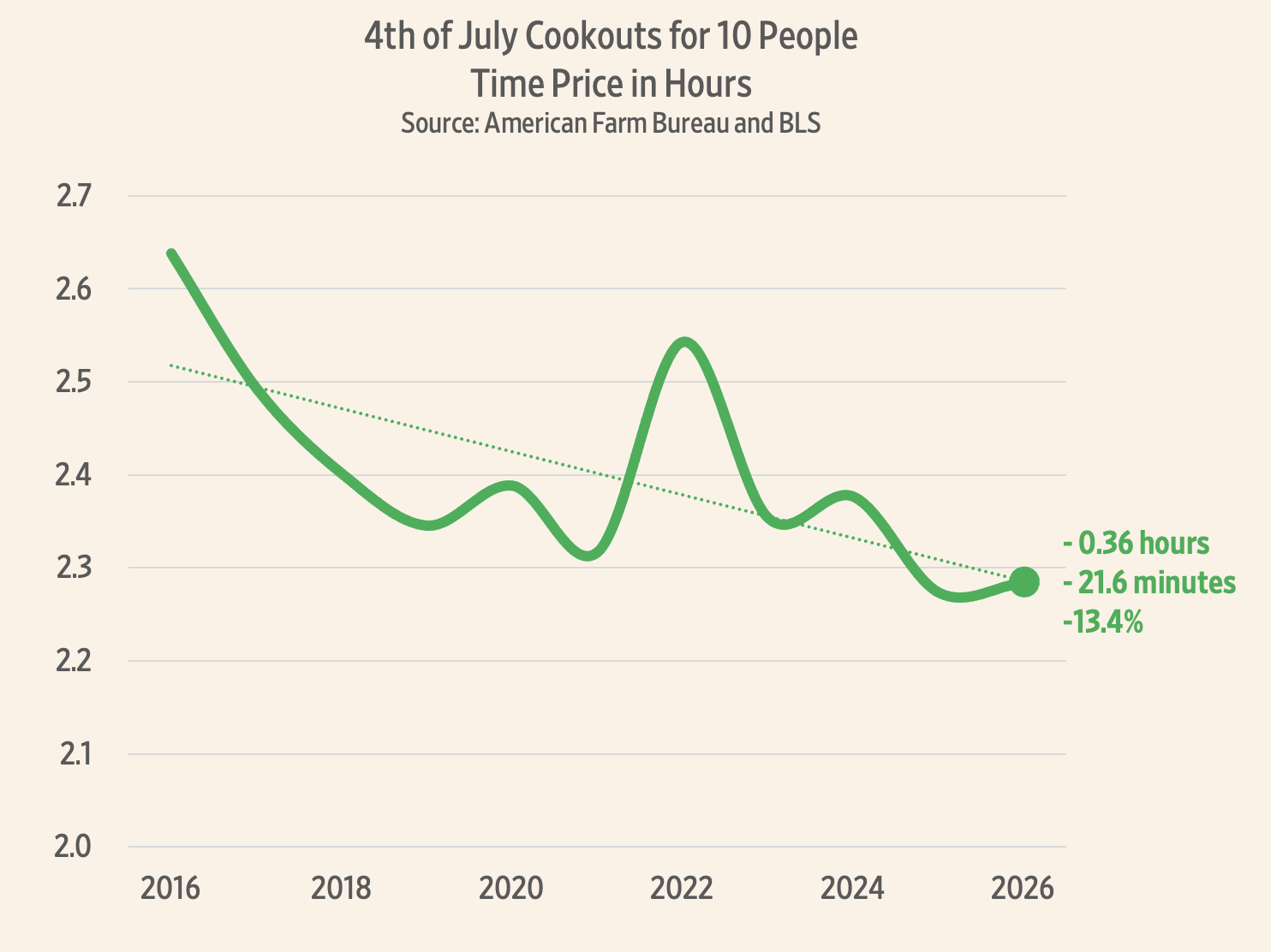
Because wages rose faster than prices, the time price of the cookout actually fell 13.4 percent—from 2.64 hours of work in 2016 to just 2.28 hours today, a savings of 21 minutes.

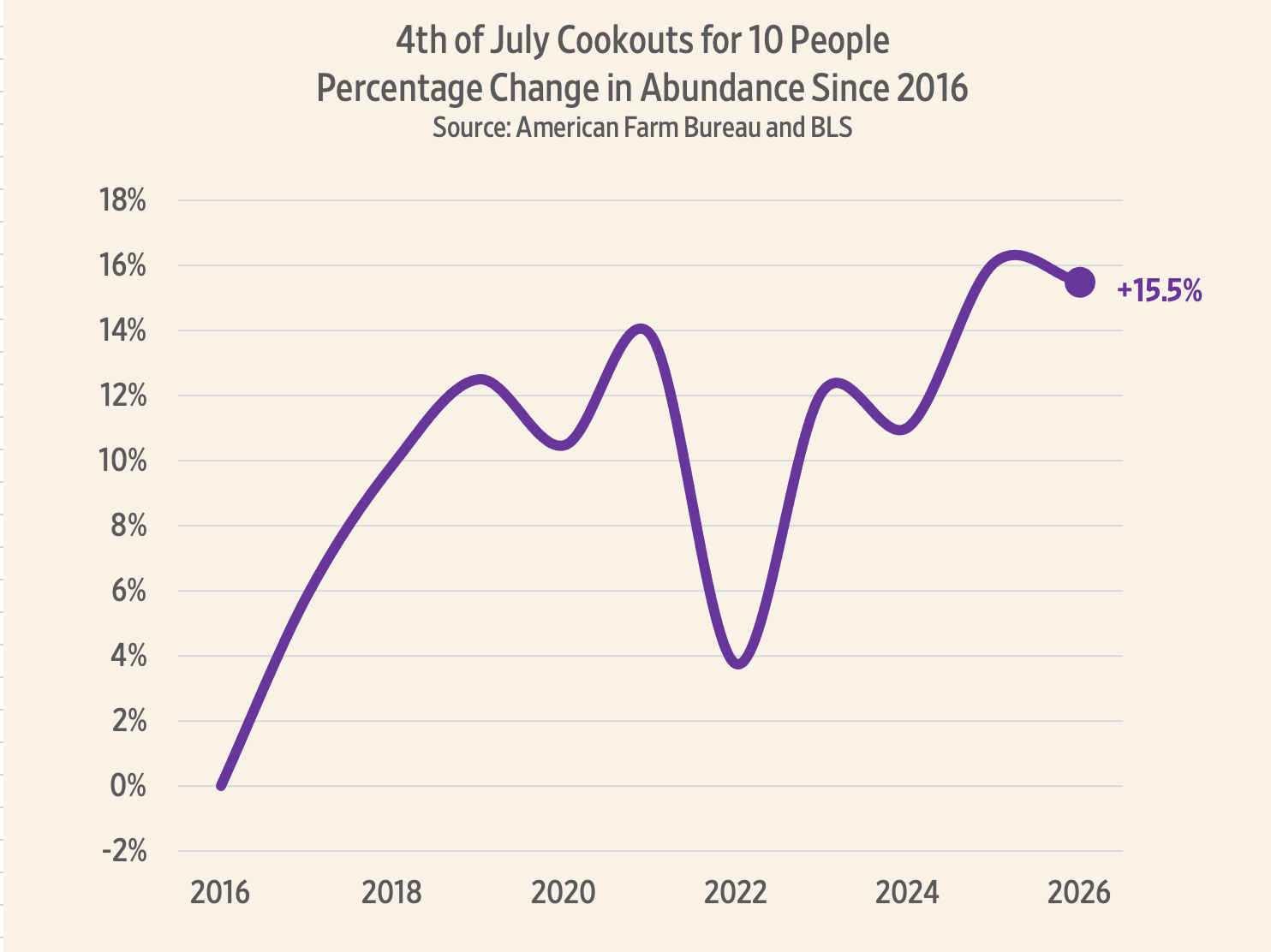
Another way to measure progress is to ask: How much more does the same hour of work buy? We call this the abundance multiplier. Compared with 2016, the same amount of work today buys 15.5 percent more.

America added 22 million people between 2016 and today, a population increase of 6.8 percent. Yet abundance didn’t merely keep pace with population—it grew 2.28 times as fast. Every 1 percent increase in people produced a 2.28 percent increase in cookout abundance. That’s the signature of superabundance: on average, every additional person contributes more than they consume. Even though there are 22 million more of us, we’ll actually spend 7.5 percent less time working as a country to pay for our celebration compared with 2016.

Americans may spend more dollars, but they spend less of their lives earning this year’s Independence Day feast.

Government money printing during the COVID-19 pandemic did cause a temporary spike, but we have returned to the long-term trend of decreasing time prices and increasing abundance.

This year saw a slight reversal. Compared with the record-low time price in 2025, food prices increased 4.1 percent while blue-collar hourly earnings rose 3.5 percent. As a result, the time price of the cookout edged up by just 0.5 percent—less than one minute of additional work. Even after that small increase, the Independence Day cookout remains substantially more affordable in time than it was a decade ago.

Find more of Gale’s work at his Substack, Gale Winds.

Economist Writing Every Day | Food Prices

Berries Are Probably Not Making Parents Go Broke

“The Washington Post recently ran a fun, data-filled article on berry consumption and parenting. Lots of good tidbits in the article, including that Americans eat a lot more berries than in the recent past, and that a lot of the availability is thanks to foreign trade and imports. But despite being somewhat light-hearted, the article does seem very negative, especially in the title and introduction, about how parents are spending a lot of money on berries…

Relative to median wages, berries of all kinds are now more affordable than a decade ago. Parents may still feel squeezed by all the berries their kids are eating, but in terms of affordability and share of the family budget, there is probably no need for a Berry Panic.”

From Economist Writing Every Day.

Blog Post | Food Prices

Time Pricing Big Macs Around the World

Even if a Big Mac is more expensive in money, it can be less expensive in time.

Summary: Big Mac prices across countries can be better understood by measuring them in terms of time rather than money—specifically, how long people must work to afford one. Comparing time prices reveals meaningful differences in wages and productivity that aren’t obvious from currency values alone.


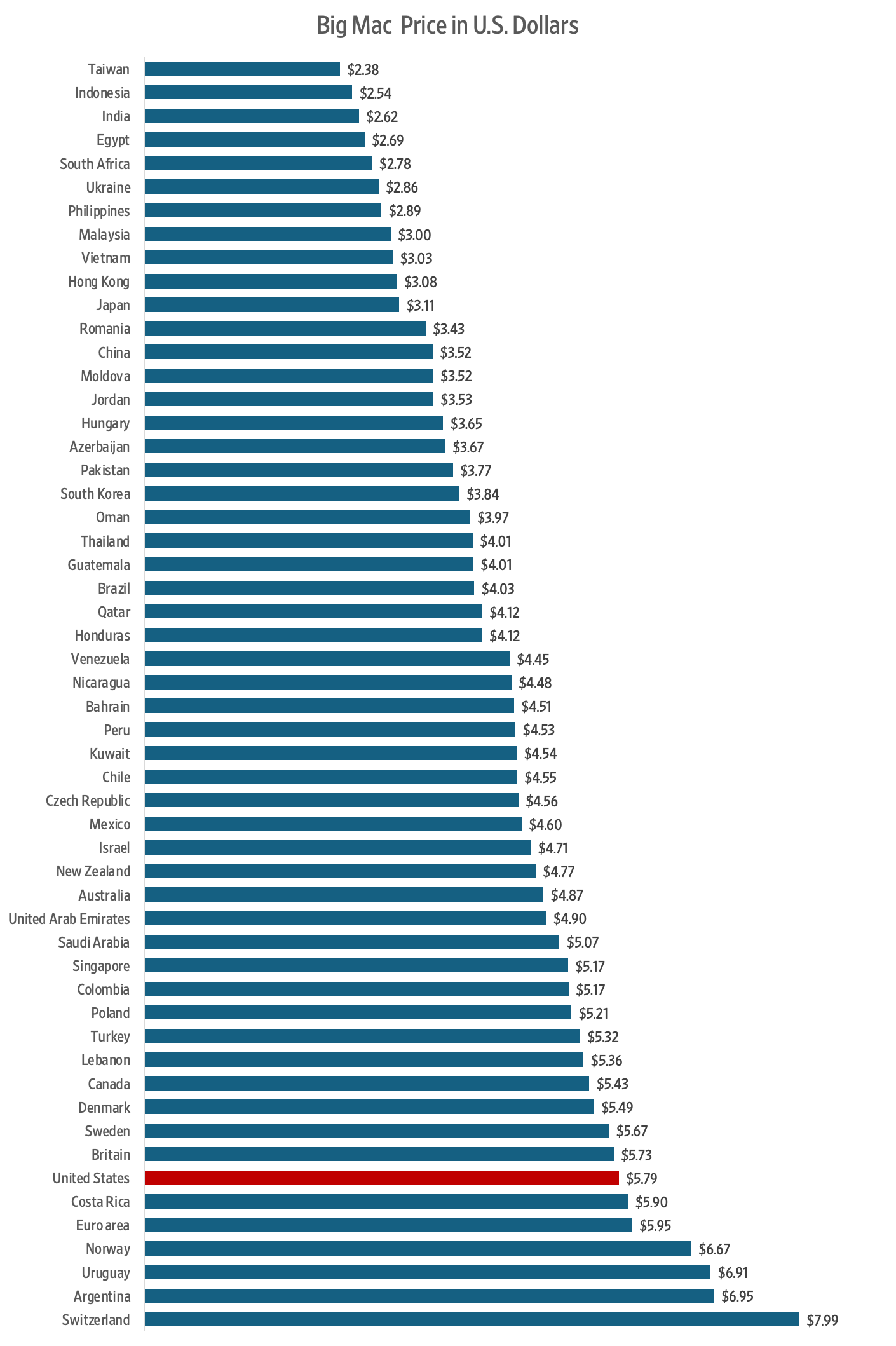
McDonald’s operates in over 100 countries worldwide. Since 1986, The Economist magazine has published the Big Mac Index, built on the theory of purchasing power parity (PPP)—the idea that exchange rates should equalize the price of an identical basket of goods across countries. The following shows the dollar price of a Big Mac in each country, sorted by price:

But we can go one step further.

Instead of comparing currencies, we can compare time.

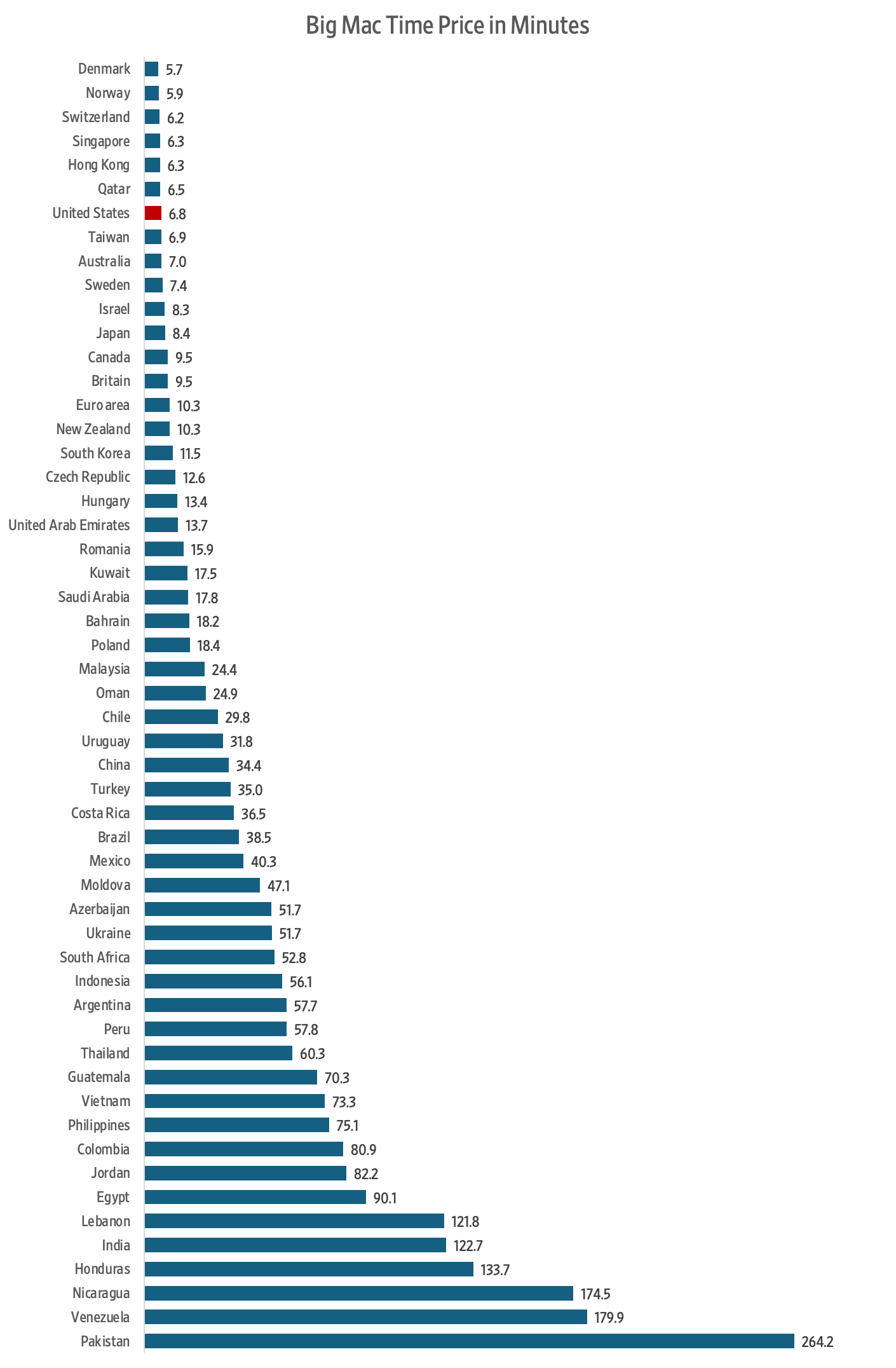
We start with the nominal price of a Big Mac in each country, converted to U.S. dollars, and then compare it to average hourly earnings. Since average hourly earnings data are not available for all countries, GDP per capita divided by annual hours worked serves as a reasonable proxy for relative wages between countries.

This transforms the question from “What does it cost?” to “How long do you have to work to get it?” A Big Mac can be more expensive in money but less expensive in time, depending on where you live.

A Big Mac in Taiwan costs only $2.38, compared to $7.99 in Switzerland, but after adjusting for hourly earnings, the time prices are very similar. In Pakistan, a Big Mac costs $3.77, but hourly earnings are $0.86, putting the time price at 4.4 hours. In Denmark, the price is $5.49, but hourly earnings are $57.60, so the time price is under six minutes. For the time it takes a worker in Pakistan to earn enough to buy one Big Mac, workers in Denmark can buy more than 46.

The Big Mac doesn’t just measure currencies; it measures the spread of knowledge.

What looks like inequality in dollars is often a difference in productivity, learning, and institutional capacity. The real divide is not between rich countries and poor countries—it is between places where knowledge compounds and places where it is constrained.

When a sandwich falls from four hours of work to four minutes, something profound has happened—not to the burger, but to the growth and sharing of knowledge.

The story of abundance is not written in dollars. It is written in time.

Find more of Gale’s work at his Substack, Gale Winds.